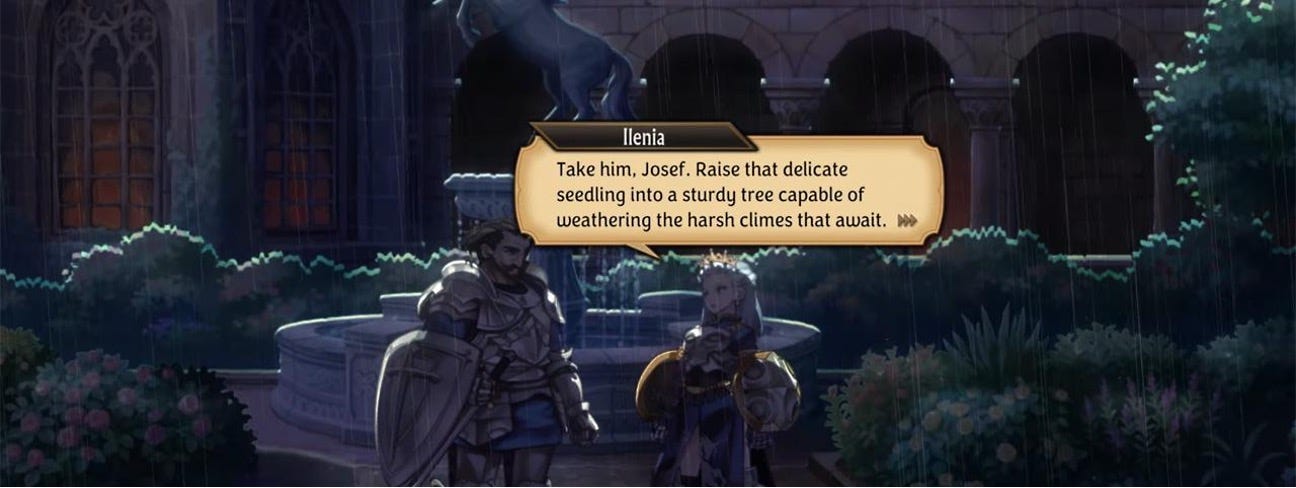
It’s a dark and stormy night. Invading cavalry ride on the capital city of our main characters, and the queen bemoans the treachery of her local lords supporting the usurping general. Pretty standard stuff for a swords and sorcery RPG, delivered without irony and a few too many old-timey flavor words. It set the tone for the journey I was about to partake in, but not without some consternation.
Right after the intro set piece and tutorial battle we get our emblematic and stoic narration detailing the story and heaping spoonfuls of Lore, then time skips to the game in earnest. At first, battles are mainly focused on deploying your unit and navigating to enemy targets. Each unit is composed of multiple characters, and are upgraded through the game to contain even larger crews.
After I cleared this first real battle, had my nice little victory screen, and faded back into the overworld map…. I was struck. The battlefield I had been navigating a minute before was now the overworld. It’s such a small thing, but moving my character around in real time, seeing townspeople milling about the fort I was just garrisoned at, getting materials from glowing spots at the coast… I don’t want to go level by level in a tactics game ever again.
As I made my way to the main continent and experienced the various different battle types, from main missions, to liberation quests focused on a single town, to side quests to recruit characters to my totally righteous cause, the formula behind the game was laid bare. There was no sleight of hand: each town needed materials, each country had its own quarry with a number of treasure maps to dig up some loot, and there were a few lost chickens here and there. This could all wear thin, but instead I was comforted by it. The formula made me look forward to what was next, like bridge to chorus.
Fitting to the formula was the soundtrack. It never rose to the heights of unstoppable ear-worms like many RPGs, but it is pleasant and bombastic and filled with suitable gravitas. Re-listening several weeks removed from my playthrough, it already feels nostalgic. Under-appreciated in the moment, maybe, and it likely won’t win any Game Awards, but it’s above reproach. The instrument choices are perfect: flutes leading the charge in Cornia’s themes to emphasize the small revolution against the imposing armies you oppose, the percussion and strings spelling out Drakenholds struggle in Cornia’s shadow, or the twinkling glockenspiel adding a level of mystique to the forests of Elheim. Each theme is simultaneously distinct and yet part of the whole, like any good soundtrack ought to achieve.
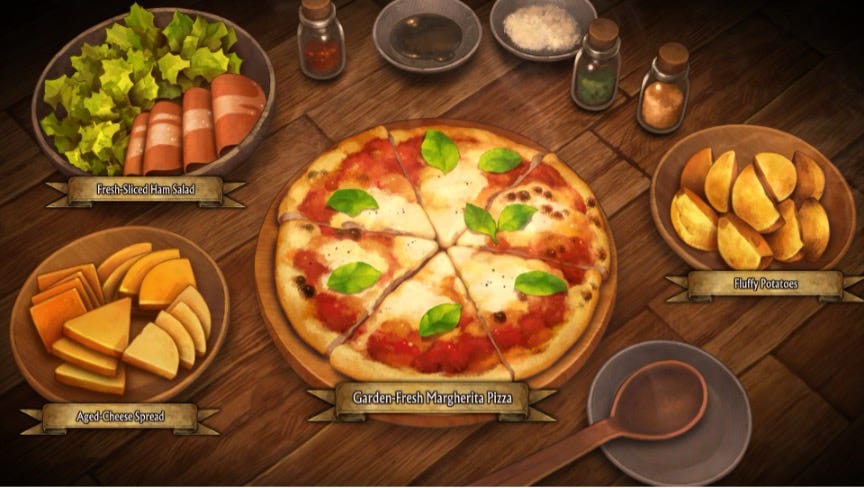
By the time I had cleared out all the quests I could reasonably tackle in Cornia, I was flush with cash. So, what do I spend my coin on? I hadn’t had any issues with the battles, so no need for more armaments. I’d buy some healing tonics and other battle use items here and there, but that was limited. So, I dropped top dollar for meals to unlock Rapport conversations, obviously.
The Rapports are the typical heart-to-heart vignettes between characters like you’d expect from any RPG these days, but they are surprisingly well delivered. There were way too many specific character-to-character interactions for there to be voice-over on any of them, but if anything, that may have made me like them more. The “budget dubbed anime” voice direction for the game doesn’t do it any favors, but I found the earnest portrayals of these character’s struggles and successes to be incredibly endearing. As you’d expect, MC Alain has the lion’s share of Rapport with the ranks of his growing revolution, and he plays the vanilla straight man well against the colorful cast, like Auch’s praise fetish or sparring with Berenice and contemplating the benefits of being adaptable versus being specialized. They did all the heavy lifting in making this nation spanning journey feel like time was actually passing, and that everyone was doing their parts on and off the battlefield.
Though Unicorn Overlord never got to the point of overwhelming me, it walked the tightrope of introducing wrinkles and exposing depth in its systems while not punishing me if I didn’t do my homework. For the first handful of hours, systems would be elaborated on, and many classes were made available either through quest recruits or from hiring mercs from the many forts dotting the continent. As I extended my number of units and expanded them up to hold more characters, the variety grew exponentially and menu maintenance became the meat of my military machinations. Each tough scrape would force me to reconsider my schemes, from the mile-high approach of reconfiguring my units to the nitty-gritty of modifying my Tactics.
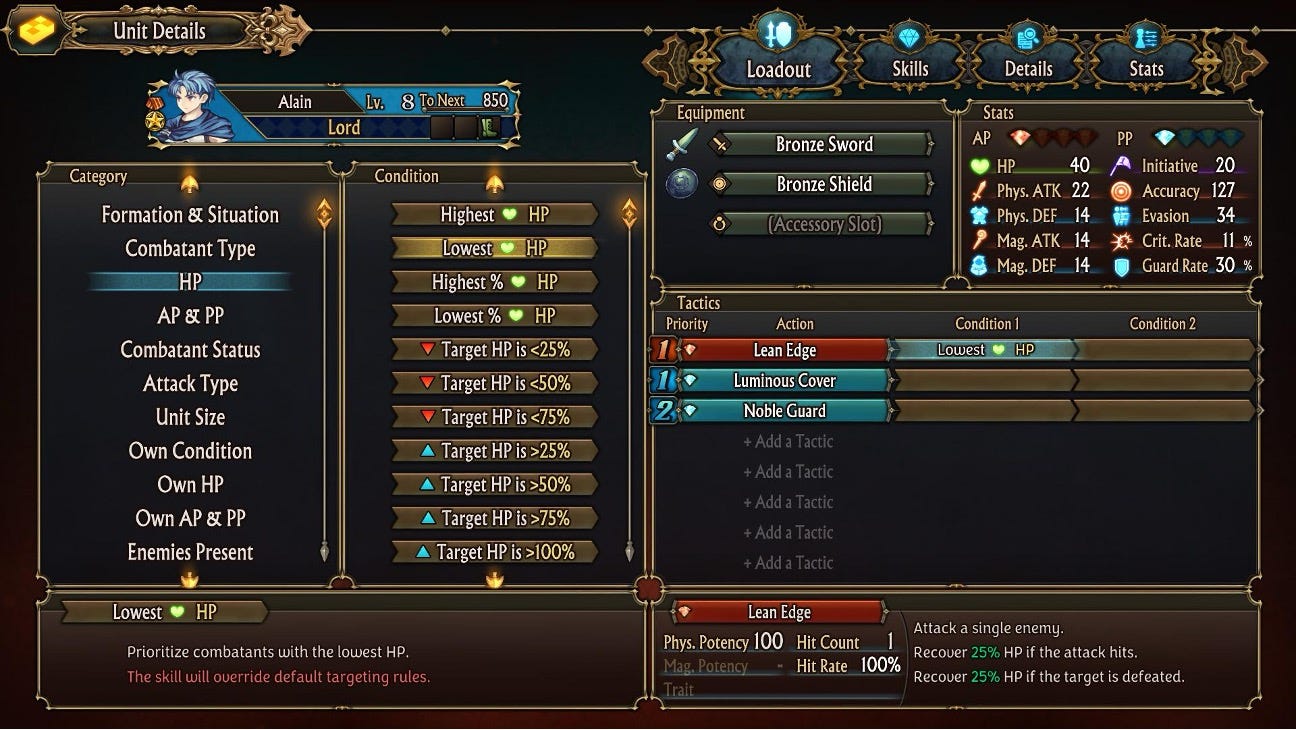
The Tactics Menu is the star of this game, no argument. When you jump into a battle, it plays out in an automated tableau of Active abilities which can then trigger you or your opponents Passive abilities. Have a healer in your team? The default may have them heal the other units whenever they get hurt, no matter how small. But you can set their healing to only affect a teammate once they get below 50% health, or if the average health drops below a threshold, or if they were attacked by an archer, or if the healer has 2 or more AP, or….
It’s not just the depths that are rewarding, but the higher level management of per-unit Stamina and army-wide Valor points. When depleted of Stamina, a unit is incapable of moving, and are at risk of an enemy descending upon them and having attack priority. So as you progress through a battle, you need to keep rotating your units so they don’t get over-used and become vulnerable. Stamina is also used by Assists, such as an archer providing cover fire from a nearby tower, or a healer topping off a struggling ally as they face a powerful enemy. Similarly, Valor skills use a shared pool of points earned through defeating the enemies that litter a battlefield or liberating towns and forts. These powerful abilities can provide direct damage, render your enemies incapable of assists, or slow down opposing troops as they try to maneuver the terrain. Best of all: the enemy can have these abilities as well. So at any moment, my fleet of flying units could get absolutely wrecked by a well placed barrage of arrows. I love when games give my foes the same abilities I have: it turns into another way to teach me how to play, and the opportunity to Uno Reverse my way out of dire straits.
That level of granular tuning kept making me feel like a big brain badass, laying waste to every Zenoiran loser in my path. Until, suddenly, I hit a unit comp that for some reason is just hard-countering my winning strat…. Uh oh. Time to re-tune. Tweak some tactics triggers, make sure my equipment is all up to snuff, pop some healing items, rearrange my lineup… Bam. Winning again. I found the on-the-fly arranging to be more informative as I got to see the battle preview and see for myself where I should keep my tanks and damage dealers.
The primary knock during my playthrough was the infrequent difficulty spikes. Based on the description of each difficulty, I went with “Tactical”, and I may have wanted it a step above that. It is the 3rd of 4 options, describing itself as For players familiar with strategy games. I’m certainly familiar, but I wouldn’t classify myself as especially skilled, so I don’t know if I would have gotten along with “Expert”. During most areas of the game I was somewhat overleveled, probably because I was doing every single quest I unlocked, but I feel like the challenge rarely presented itself outside of a handful of inconsistent scenarios. Not some end of level boss fight, or introducing a new unit type, but at seemingly arbitrary points there would be a stopping block in my path. Maybe it was just because of how varied any individual player could set up their units and tactics, but I would have loved regular challenges at more sensible intervals to punctuate my progress.
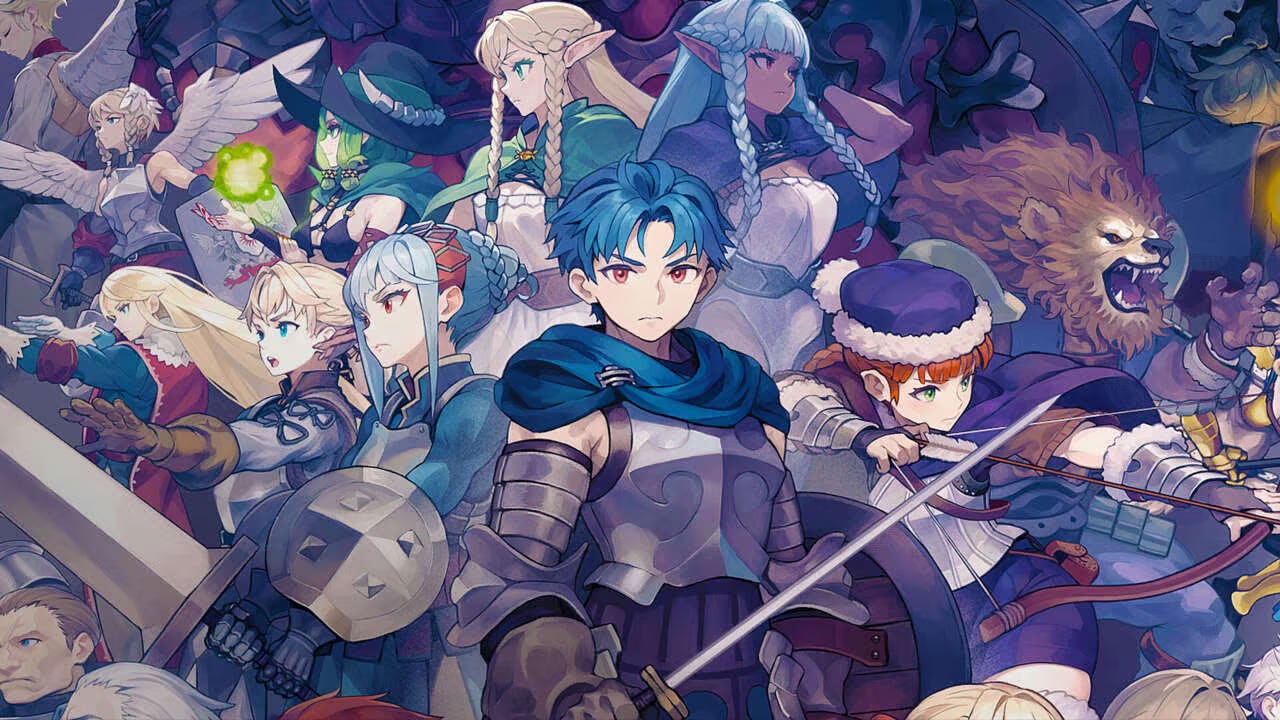
From an art and presentation standpoint, I now totally get it: Vanillaware is at the top of the game. The character illustrations are beautiful, the painted backgrounds are lush, the environments I got to traverse are dense and detailed, with the depth of field slider tastefully applied. Rapports have the charm of a 16 bit RPG without the heavy-handed pixel art that so many retro inspired titles employ — and it’s not missed. “Real” cutscenes utilize the full-size character models from battles, and the scope of animation is like a thoughtfully blocked out play. In keeping with the pristine visuals was the performance: no dropped frames, no glitches seen or heard, and each quick-travel loaded in a blink.
Though I spent dozens of hours with Unicorn Overlord and my massive menagerie of misfit mercenaries, it breezed by and ended as easily as it started. One post-game mission, a little bit of tooling around in the Colosseum, but there really wasn’t much more to do once I’d beaten the game, unless you really want to start a new save with the freshly unlocked hardcore difficulty. However, I love when a game can just end: the kingdom is restored, the peoples are liberated, and the future secured. Now I just have to hope for a sequel to be announced, because there is a huge opportunity ceiling on this game, and I want more.
Verdict
Each Victory in Unicorn Overlord is a triumph in strategy gameplay and a feast for the dopamine receptors. My 80 hours in the game melted away, like binging a great season of television. In a year packed with amazing role-playing games, don’t you dare skip this one.