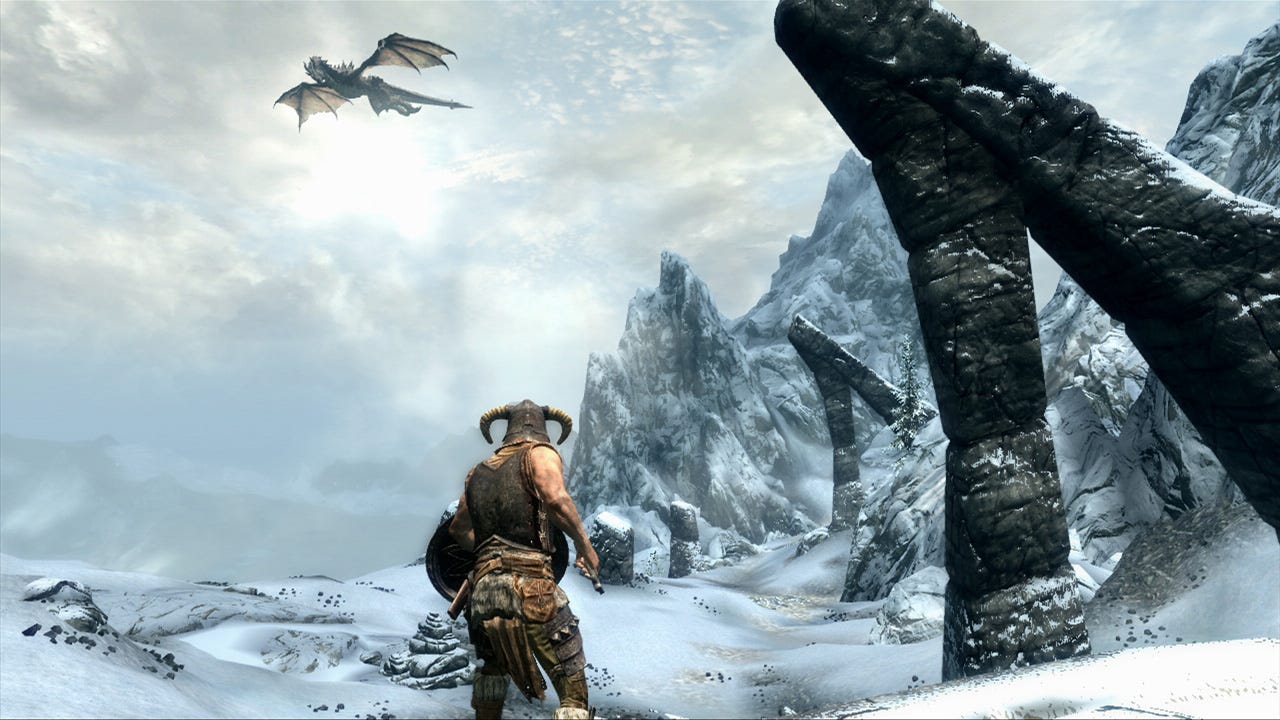
The Elder Scrolls V: Skyrim released in 2011 to near-unanimous praise, and has since sold over a whopping 60 million units across nine different iterations. I’m hardly alone in my adoration of this game, but it serves as the title that brought me back to video games in a big way almost fourteen years ago: Console Crusade wouldn’t exist if not for the influence of Bethesda’s epic fantasy RPG, and to this day I’m grateful I discovered it when I did — a fresh-faced 19 year old, living on his own for the first time, in desperate need of some escape after long days working two jobs. It was groundbreaking in its time, and over the years has become your favorite RPG’s favorite RPG; it is without question one of the most influential games to ever exist. But the further we get from its initial release, I find myself fearing we’ve reached a point of no return when considering how well it might hold up to modern scrutiny. In 2024, after years of neglecting Skyrim’s robust expansions, I was determined to finally conquer this title in its entirety: the platinum trophy would be mine. In the process, I was gladly reminded that this game is more than the sum of its parts, a lovingly crafted backdrop that enables players to fully immerse themselves in their own brand of storytelling.
The sheer spectacle of Skyrim has been far surpassed in recent years, but the world Bethesda’s crafted remains uniquely beautiful in a landscape littered with oversized, lifeless maps stuffed to the brim with NPCs you can’t interact with, trash you can’t pick up, and nothing more than a few nicely rendered trees to stare at while meandering from waypoint to waypoint. Of course, without proper context at the time, there’s no way I’d have been able to articulate what made this game so mesmerizing when it first released, but today I recognize what continues to make this game so special. The focus isn’t necessarily getting to the end, but crafting an experience wholly unique to the player, a story that could unfold a thousand different ways. Skyrim was the peak of this design ethos in 2011, and the first game to truly utilize the power of 7th gen consoles to bring a smattering of disparate industry ideas into one complete package — and its DNA can be seen literally everywhere these days, from the likes of Elden Ring to the most recent Zelda offerings. Player freedom is paramount, as one isn’t beholden to any specific path, and the game does a great job of rewarding exploration with meaningful discovery almost anywhere you go, in any order. It’s an impressive feat of game scripting and design, as the decisions you make have a genuine impact on how the rest of the story plays out and how NPC’s interact with you, but rarely lock you out of content entirely. It’s a delicate balance between giving the player genuine agency and doling out consequences for their actions, but also ensuring that content tourists are still able to reliably get the most out of the game at any given moment.
Booting up for the first time in years, I nervously questioned whether my modern sensibilities would reject something that wasn’t up to the visual standards of today; Skyrim is in many ways a beautiful game, but it’s never exactly been nice to look at. Years of updates, iterations, and revisions have left the title just clinging to what I’d consider ‘passable,’ but I was quickly reminded that the appeal of this world lies less in its raw graphical prowess and more in its ambience and deliberate, granular design. The Anniversary Edition does, however, bring with it a resolution increase, some framerate enhancements, and a lighting overhaul previously introduced in the Special Edition a few years earlier, and is both the nicest looking and most performative vanilla version ever released. There was a freedom in experiencing a polished console port of this game, no longer concerned with squeezing as many frames out of my PC as possible, or tweaking .ini files to fix z-fighting in the mountains. And while it’s wonderful how Bethesda’s support of the modding community has enabled a generation of budding artists and developers to cut their teeth contributing to one of the greatest games ever — I’ll always be grateful for the hundreds of additional hours playtime those creators afforded me — just this once, I was glad to leave that all behind and play through the game free of the burden of modularity.
Getting through the first main quest objectives and chatting with a few townsfolk quickly reminded me just how dense this world was — I was daunted by the task ahead and felt like I needed to focus on how my character would navigate this playthrough. The sheer amount of content in the game meant that there would be a few inconsistencies I’d have to iron out in my own head in order to feel the level of immersion I’ve come to expect — faction quests, for example, end with the player becoming leader of that faction’s respective institution, a trope that can come off a little silly when the person running a centuries-old institution of magic in Winterhold is also sneaking around the sewers of Riften snatching ornate dinnerware for the Thieves Guild.
Historically, my time with this game (and others like it) would be informed by habits developed during my time with Star Wars: Knights of the Old Republic; namely, choosing to do separate ‘dark side’ and ‘light side’ playthroughs, so that I could neatly compartmentalize all the offerings of these enormous RPG’s into some sort of loose headcanon. Given my decision to platinum this game in a single playthrough, however, I had to do something I don’t generally do in RPG’s: actually role play. I found amusement in formulating a proper script as I went on, crafting my headcanon with a little more specificity. I felt like I needed to make things make sense for my character, lest he be nothing more than a transient sociopath, wreaking havoc across the land. Thus, Kasha was born: a middle aged Redguard, probably suffering from some kind of PTSD developed during the war, living alone in the mountains of Skyrim. After evading execution and learning of my fate as Dragonborn, I absconded back into the wilderness, refusing to take part in whatever the fates had for the realm, set on living out my days in exile.
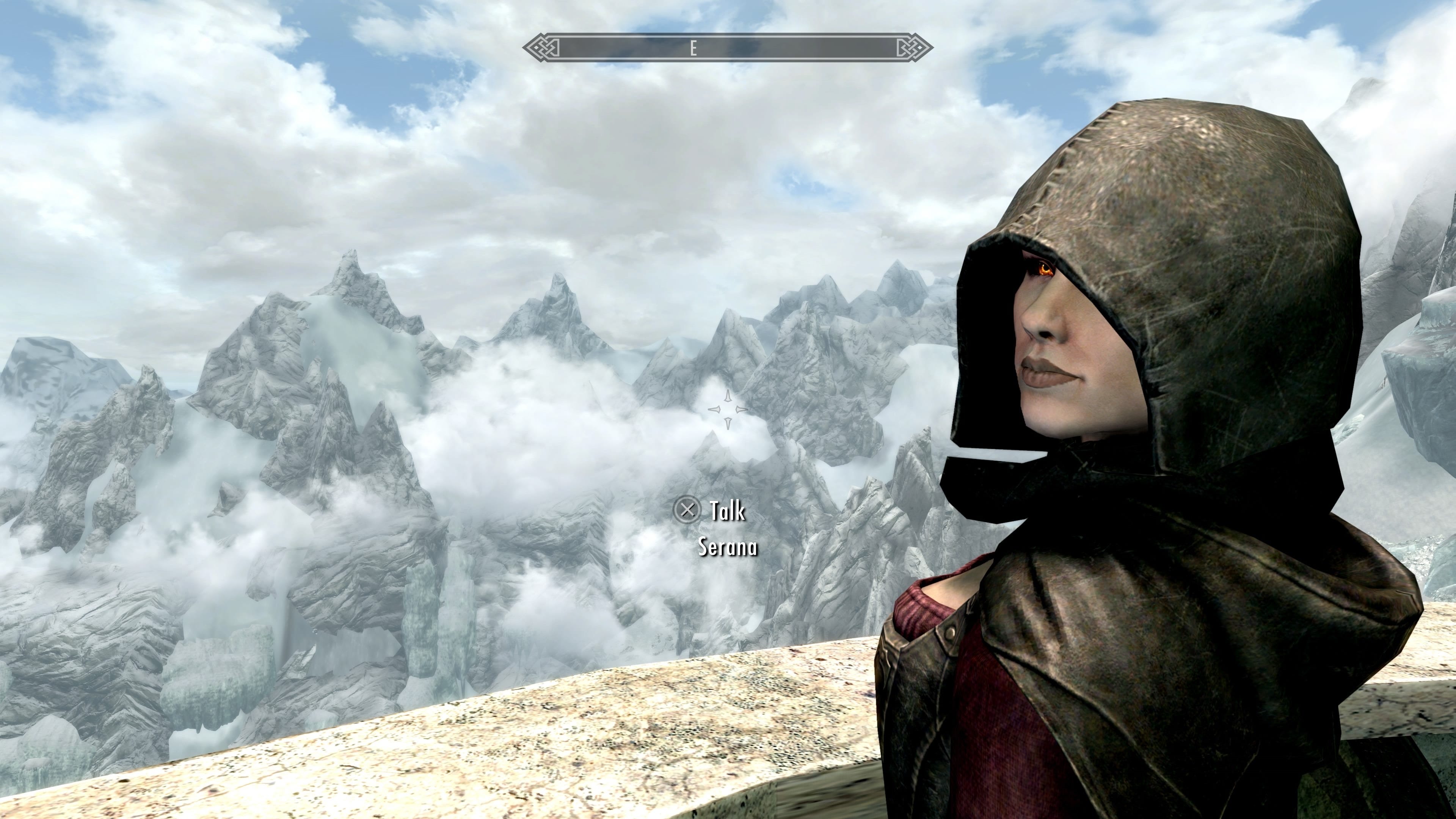
Unfortunately, the fates had different plans for me. My journey began when I stumbled across a shrine to one of many Daedric Princes — I was soon whisked away on a mission to recover a particularly powerful artifact, fearing what would become of me should I refuse. It was hard not to fall into a thirst for power, though, as I began seeking more of these weapons, and I quickly parlayed my newfound desires into infiltrating the Thieves Guild — and later the Dark Brotherhood — as I became obsessed with building influence across the realm, growing desensitized to the violence I was committing. I eventually rubbed shoulders with the Dawnguard, a group of vampire hunters who tasked me with exploring a nearby tomb, where I would meet the vampire Serana. At first, my only intention was to use her to become a Vampire Lord myself, harnessing their immense power to continue my own quest for dominance, but I soon came to see the good in this person, someone who never asked to be the way they were, and who rejected destiny to claim her own agency in the world. I was shaken, my own worldview starting to shift. I partnered with Serana to destroy her own father, thwarting his plans to snuff out the literal sun, and eventually vowed to only use my powers for good.
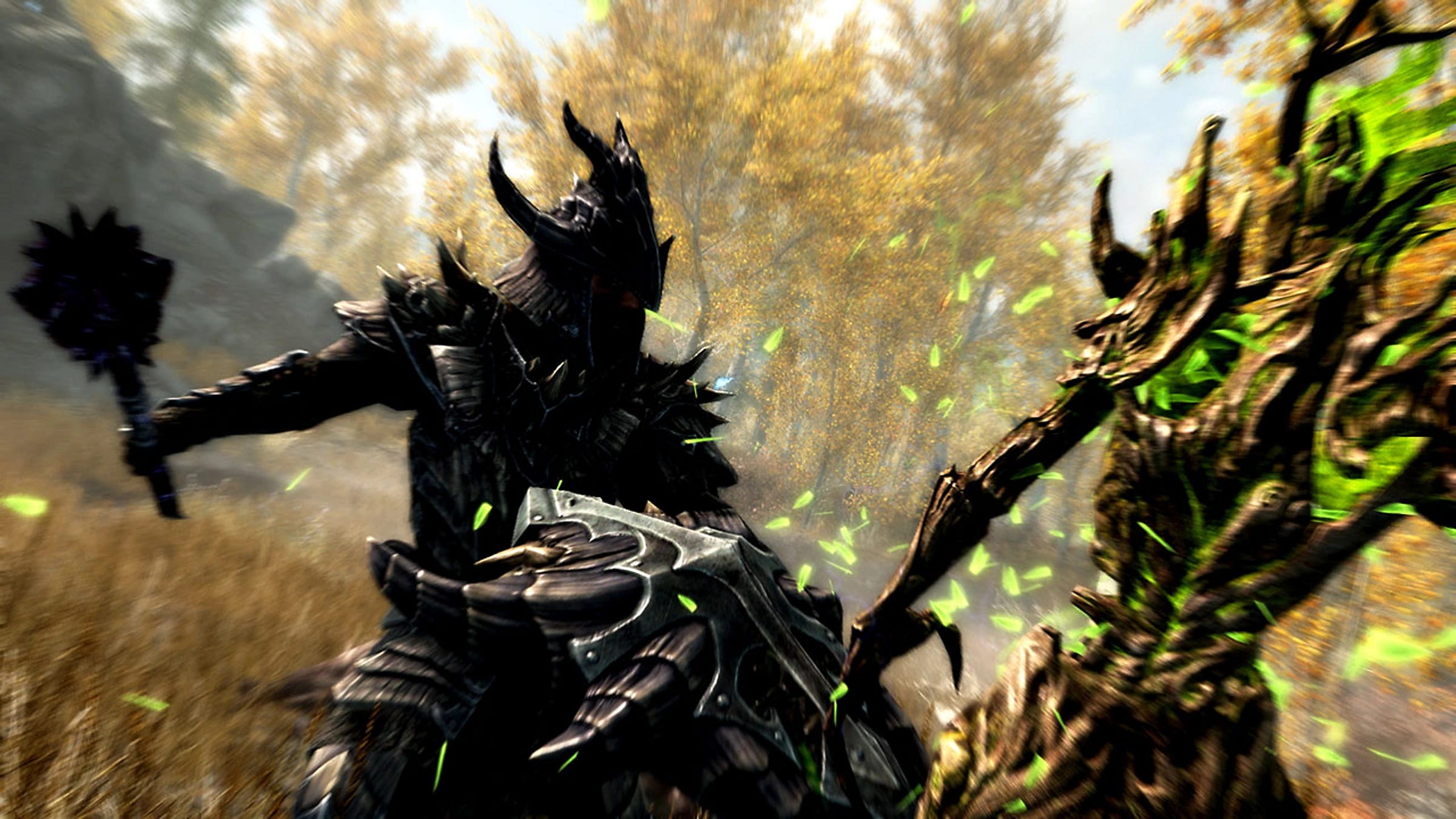
So I did just that. I helped put an end to the war, joining the Imperials in snuffing out a xenophobic rebellion; I sought knowledge at the college of Winterhold, stopping a Thalmor plot to harness a powerful ancient artifact; I laid to rest the Harbinger of the companions, freeing his soul so that he may one day bask in the glory of Sovngarde; and I eventually traveled to Solstheim to destroy Miraak in order to hone the true power of the Dragonborn, before making my way back to Skyrim to defeat Alduin, the World Eater, and completing my redemption arc.
The whole exercise was a mostly meaningless way to keep the revolving door of fetch quests a little more interesting to me, but I found gratification in crafting my character’s story as the hours marched on. This game asks the player to approach it with a certain level of suspension of disbelief — our imagination is just as important to this experience as any set piece or shred of lore. Skyrim gives us the tools to write our own stories, and doing so in a much more explicit way made for one of my most enjoyable runs yet.
My time with this game wasn’t perfect, though. Condensing such a thorough playthrough into two short weeks meant that all of Skyrim’s flaws were laid bare, at times turning my save into a speedrun of frustration. There are aspects of the game that have always been middling; combat is simple and imprecise, utilizing a strange stamina system where rotating an analogue stick will alter which attacks you’re using; a map that soon becomes impossible to navigate amidst the hundreds of crowded waypoints; a magic system that requires you to go into a menu and scroll through an alphabetical list every time you want to change spells or heal; dungeons that come in exactly two flavors, draugr tomb or ancient Dwemer city; a perk system that punishes you for exploring different paths, not providing an easy way to respec your character; and a voice cast that — while featuring all-stars such as Laura Bailey, Max Von Sydow, Charles Martinet, and even Lynda freakin’ Carter — drives you absolutely crazy due to the number of repeated voices you encounter, whether because multiple NPC’s are spouting identical voice lines at you, or just the sheer magnitude of different characters voiced by one of four actors.
The difficulty curve is perhaps my largest issue with this game, though. Instead of becoming a power fantasy where you turn into god and absolutely wreck everything in your path, Skyrim scales enemies to your level. I understand the concept (and even the necessity for a system like this), but the fact that trash mobs were more difficult to fight in hour 100 than they were in hour 10, taking 3-4 times longer to kill after becoming fully kitted and specialized, is downright ridiculous. The incentive to grow stronger quickly dissipates, and I found myself routinely avoiding the tedium of prolonged encounters that offered more annoyance than they did challenge. Given my past experience with Skyrim, I was surprised this is what I beat my head against the most — especially considering its history of game-breaking bugs.
Talos knows Bethesda is infamous for a particular brand of jank — and while there were an order of magnitude fewer issues in the most recent Anniversary release, I still had some permanent game-altering experiences. The biggest frustration for me this time centered around decision making that shouldn’t have had such unintended consequences. Early in this playthrough, I decided to stick with questlines I hadn’t explored as much over the past 13 years. This meant committing a few grisly murders as I climbed the ranks of the Dark Brotherhood, a path I’d always felt a little too...moral to follow. But I’m a sicko now, ill with a compulsive need to collect as many meaningless achievements as possible, so delirious with the platinum fever that I’d just as soon stab a man over a petty disagreement as I would assassinate the emperor of Tamriel for a few thousand Septims…or one silver trophy, anyway.
An early hit of mine was a man named Helvard, Housecarl to the Jarl of Falkreath — at the time, a seemingly innocuous request, a side mission doled out by one of many characters whose names I’ve already forgotten. The victim toiled away in the smallest hold in all the realm, holed up on the top floor of the Jarl’s meager bunkhouse in a room hardly large enough to house a twin bed; his fate was of no consequence to me. Unfortunately this footnote of a murder meant that 130 hours later, I’d have such a negative disposition with Jarl Siddegeir that the questline for becoming Thane of Falkreath just wasn’t accessible anymore. The quest dialogue wouldn’t trigger, because this man hated me for what I’d done to his Housecarl. I killed Helvard in the dead of night, his door shut, so silently that he was never even discovered! He was such a nobody that his soulless husk remained in the exact position where he had been slain almost 300 (!) in-game days prior, the spark of his life smothered in shite and splayed across an ornate bedspread not 20 feet from where his haughty Jarl pal sat hunched over in his throne every day. Just lying there! And yet somehow, despite accruing no bounty for the kill, I’m so hated in Falkreath that all this asshole Siddgeir will say to me is “something you need, you miserable wretch?” Yes, I need your sudden omniscience to be patched so I’m no longer completely locked out of an entire set of achievements for a paid DLC!
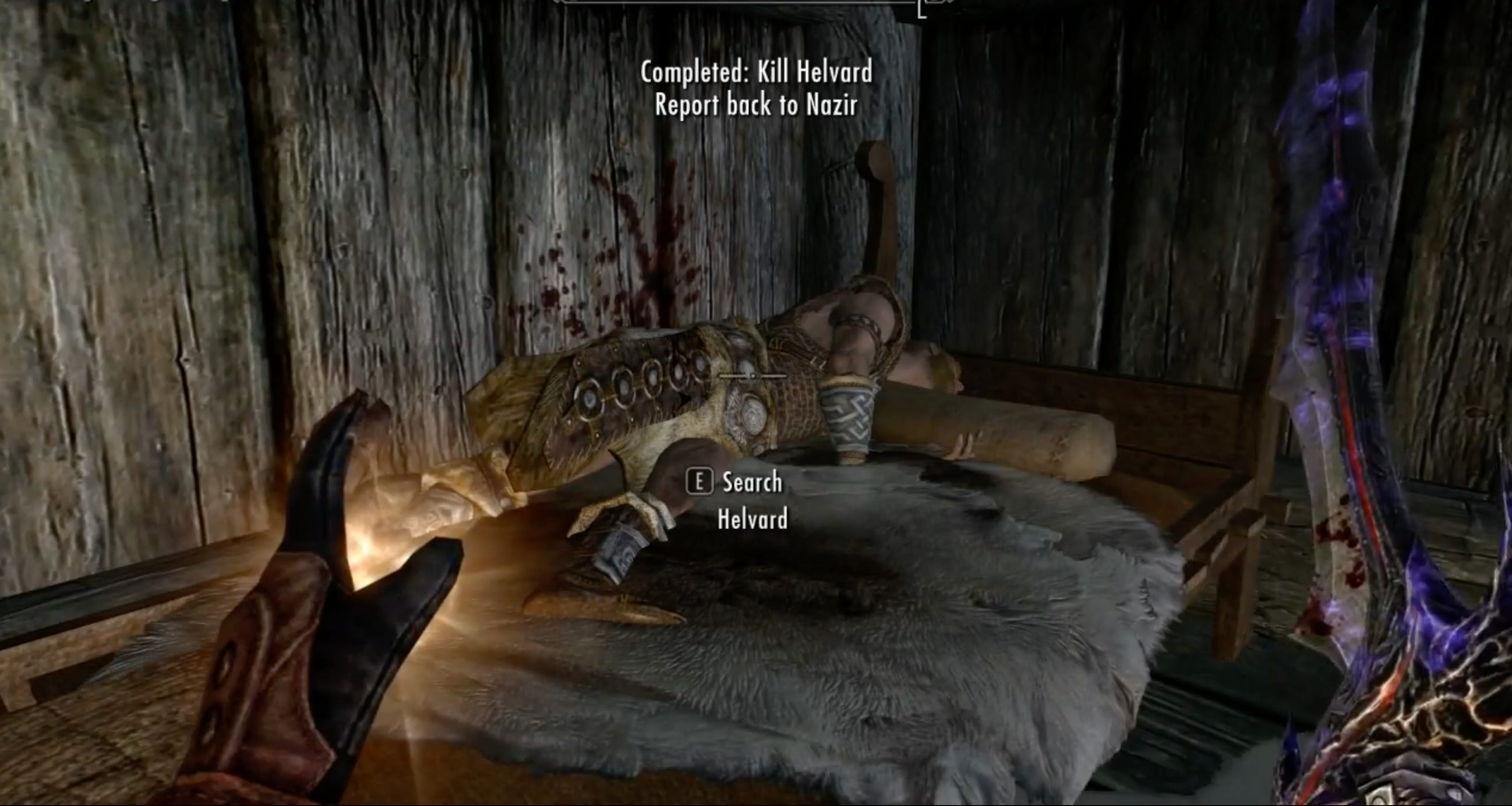
As I unfortunately discovered, if I’m unable to become Thane of this particular hold, then I can’t purchase land and build a home — a feature introduced in 2012’s “Hearthfire” expansion — and the last few achievements I need to 100% this game become unobtainable. Earning a platinum trophy without 100% completion will never sit right with me, but I’m not so far gone that I’d start over from scratch just for two optional achievements. This is my cross to bear.
I did experience a few more conventional issues along the way, such as NPCs being killed during a main quest, rendering miscellaneous objectives impossible to complete. There were moments where a scripted event didn’t trigger, leaving my character stuck in a room with no escape, or locking an NPC’s dialogue in a loop, or forcing an animation to repeat over and over. It wasn’t anything loading an old save couldn’t fix, however, and the relief I felt getting through the platinum trophy — on a PlayStation 5, in a vanilla version of the game, without console commands or unofficial bug patches — was immense.
The impetus for my return to this world, of course, was rooted in completing the trophy list, but I won’t belabor the point any further: this list is good. It offers little in the way of additional challenge (needing to have 100,000 gold on you at once is a little obnoxious) but that’s welcome given the scope of the game itself. Instead, Bethesda asks that you complete all of the faction quests, finish the main story, hit level 50, clear a bunch of dungeons, kill a few dragons, discover a myriad of locations, and blow through a couple miscellaneous objectives. That’s great! I’m being rewarded for just playing the game. The best part is: no difficulty related achievements, and all of it can be done in a single playthrough.
Despite the march toward completion, I savored my time spent back in this universe. Skyrim is host to innumerable moments of an almost aching beauty, punctuated by a strange, wistful nostalgia for a place I’ve never been before. The melancholy of the open world is breathtaking at times, and the haunting score — occasionally relieved by a pleasant orchestral flourish or bolstered by a sweet choral refrain — kept me grounded, often forgoing fast travel just to be in the moment a little longer. And while Skyrim is decidedly high fantasy, it doesn’t feel like Middle-Earth, or Azeroth, or any number of its other video game contemporaries; it feels like Skyrim, wholly unique in its simplicity. The saturated palettes and exaggerated garb of modern fantasy had long since lost its luster, and the world of The Elder Scrolls V was a welcome reprieve in its day — and remains so. It’s still steeped in a deep, rich lore waiting to be discovered by those willing to seek it, but rings more of a time and place readily recognizable than one that existed a long time ago, in a place far, far away.
While the awe of being accosted by a dragon on a lonely path of some windswept peak has long since faded, I can’t help but yearn for a return to a world this vast, with this level of detail and imagination. Many have attempted to emulate the best of Bethesda’s formula, but few have managed to capture the magic of Tamriel’s northernmost continent. I desperately hope Todd Howard and his team are able to learn from the things their contemporaries have pioneered in subsequent years — as well as their own mistakes with 2023’s Starfield — in order to make The Elder Scrolls VI a truly worthy successor to what is, without a doubt, one of the greatest games ever created. For now though, I’m content knowing that this game will continue to live on in a state wholly accessible to new players — even those who’ve been spoiled by FromSoftware or Nintendo’s imaginative takes on the formula. It exists not just as an important piece of video game history, but remains a shining example of an immersive world that rewards players willing to forge their own path.
At the very end of my journey, standing at the top of the Inner Sanctum in the Forgotten Vale, staring out at the frozen valley below, I hear Serana next to me, summing it up best: “let’s make some more stories.”
Verdict
Featuring a lovingly crafted world filled with opportunity to tell your own story, The Elder Scrolls V: Skyrim - Anniversary Edition is an ultimately iterative yet welcome update to what is certainly a timeless classic. Returning players and newcomers alike will find all of the magic — and some of the frustration — of this 2011 masterpiece, no longer obfuscated by constant bugs, glitches, or lack of system power.