



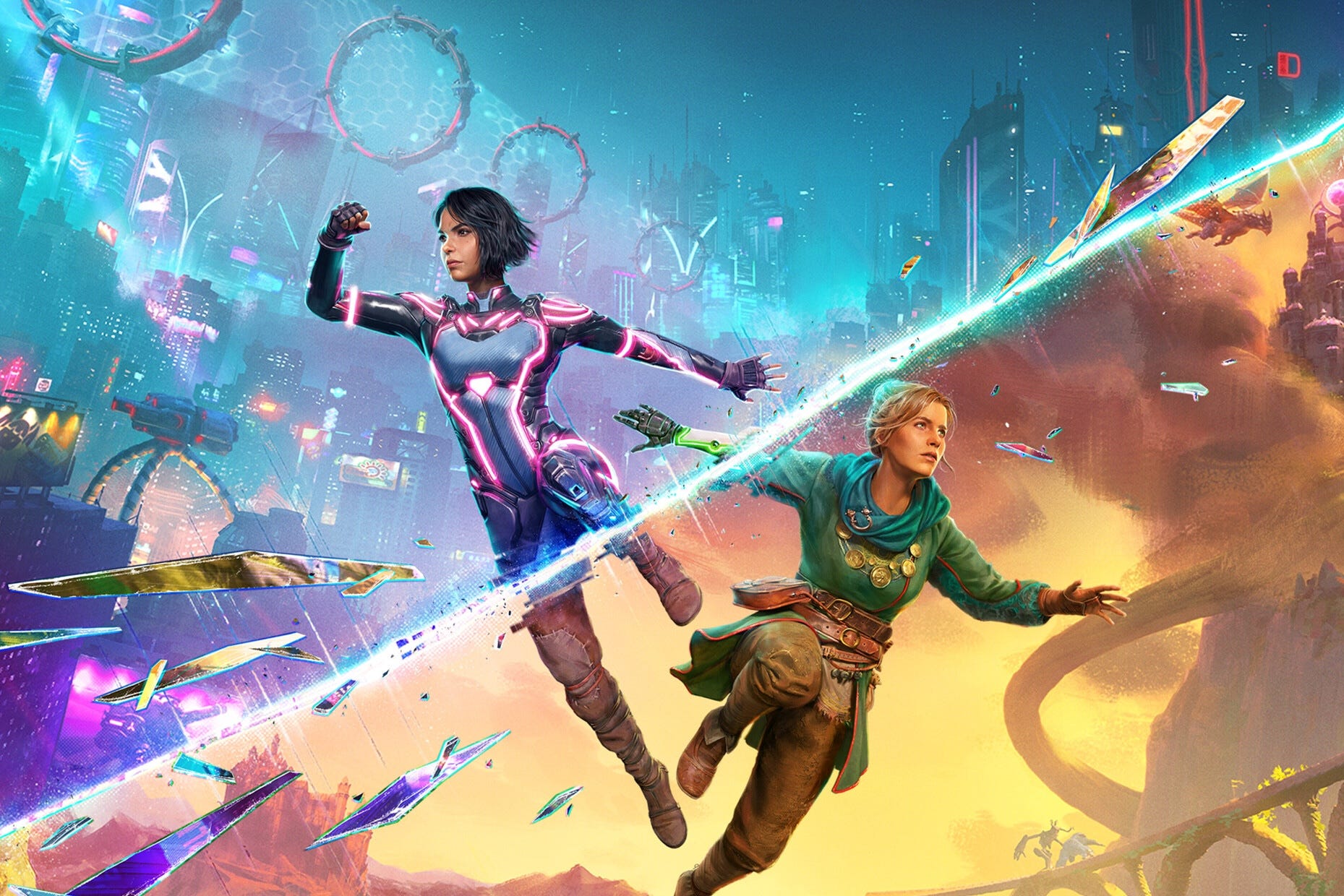
Hazelight Studios captured the hearts and minds of gamers everywhere after the surprise success of It Takes Two culminated in a 2021 Game of the Year award. Anticipation for their follow-up entry built to an eventual fever pitch last year, when braggadocious Creative Director Josef Fares proclaimed it would be “some next level shit” and “it’s really hard not to be cocky when you have a game like this.” Indeed, some confidence is certainly warranted after taking home top honors with their previous release, and given that the role Hazelight occupies in the modern game space is singular: experiences designed entirely for cooperative split-screen gaming. As a staunchly single-player or split-screen gamer myself, I often feel alienated by an industry that has rapidly moved to online-only multiplayer titles with huge player counts — what Hazelight does best surely has appeal to me.
A review aggregate that topped 90, hallowed ground reserved for sure-fire Game of the Year nominees, roused my curiosity, and so along with EJ — himself a Platinum Trophy-laden veteran of Hazelight’s previous titles — decided to see how it measures up. For a game like this, designed so intimately for cooperative gameplay, we felt it would be appropriate for the two of us to intersperse our various musings and, eventually, arrive at a mutual review score — a “split review” if you will. Look for his segments to be bordered in Mio pink on the left-hand side of your screens.
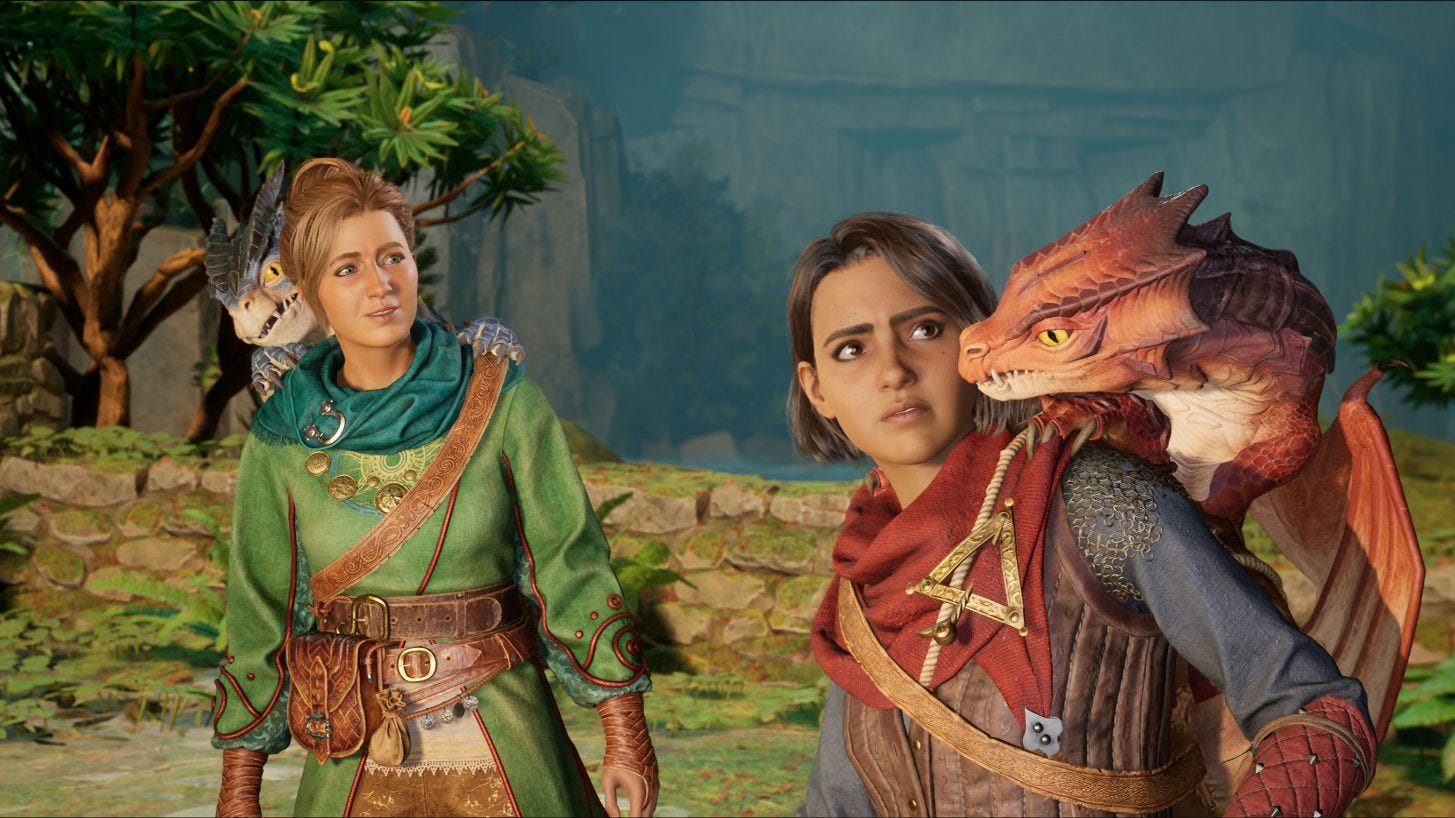
Split Fiction begins by bringing scowling cynic Mio and plucky optimist Zoe, aspiring writers both, to the headquarters of Rader Publishing on the promise of a book deal in exchange for participation in some kind of technological trial. The eponymous Rader wastes no time in showing his duplicitousness and espousing trite “bad guy” phrases to get this cardboard cut-out of a plot moving. Case in point: as Mio gets cold feet and tries to withdraw her consent, he physically prevents her from leaving the trial. Why? “We cannot shut this down now…you have to proceed.” Riveting stuff! In the ensuing scuffle, Mio falls into Zoe’s bubble, the two of them realize Rader is — you won’t believe this — out to steal their ideas with his new device, and begin to traverse fictional worlds split between Zoe’s fantasy locales and Mio’s science fictions settings (hence the title).
The less said about the narrative and where it goes from there, the better — but as the game relies heavily on the plot to carry its weight, it bears discussing. The writing rarely ceases to be “MTV Original” levels of awful, replete with clunky dialogue seemingly ripped straight from Rader’s story-stealing AI machine, heavy-handed character reveals, and several hackneyed tropes. You may not be shocked to discover that Mio is cynical for a reason — and you will also not be shocked at how rote and generalized the underlying cause is once it’s revealed. The dithering Zoe similarly holds onto a dark secret, one of the story’s rare moments of actual heft — but by the time we get there late in the game, I was so worn out by the paint-by-numbers development their friendship and individual characters experienced that I could barely be bothered to care. Otherwise, it’s a straight ahead “get outta here” story for the two women as Rader behaves (and talks) more and more like a sock puppet villain. Eventually, EJ and I started playing a game of “guess the ensuing line” that moved from hilarious to downright depressing as we were able to no-scope just about every word these people were about to recite.
Fun fact: I initially started this game with another friend, who I platinumed Hazelight’s previous titles with — two cutscenes in, he begged me to start hitting the skip button. When I refused, he likewise refused to play the game with me any longer. Sorry bud, I had to endure it for science. Also you owe me fifty bucks.
Where It Takes Two’s narrative just kind of existed, equally rote and poorly acted, it didn’t distract from an interesting world, full of wonder and things to discover. Here, it is the glue that attempts to hold a multitude of disparate ideas together, a single through-line meant to make Split Fiction feel like a cohesive experience. It’s a fine concept, but one that relies heavily on the narrative being…good. It falls flat here, too simple in its allegory, and in turn mostly hurts the actual gameplay. - EJ
A weak narrative won’t necessarily sink a game that otherwise has a lot going for it in terms of gameplay systems or audio-visual presentation, though. For the latter, let me say this is definitely a good-looking game. It runs at a smooth 60 frames and each environment is rendered beautifully and with great detail. I probably couldn’t tell you the aesthetic differences between most of Zoe’s fantasy realms in the same way I could about Mio’s — an imbalance that persists through several aspects of this game’s design — but they are nonetheless lovely, and the music throughout is alternately soft, instrumental, and evocative, or electronic, pulse-pounding, and catchy as we toggled between their respective zones. Gameplay-wise, this title runs the gamut. Each main level and side story contain bespoke abilities for each character underpinned with a standard run/dash/double jump/grappling hook movement system. Most of the time the traversal works well enough, but we did have a handful of head-scratching instances of wondering why the button command for a grapple swing failed to populate before we went plunging to our digital doom.
A note on the visual design language: something their previous title did exceptionally well was craft a proper sense of scale — much like Uncharted or God of War — by utilizing the camera to convey genuine wonder in the world. Here, it doesn’t translate at all: instead of making the environment and its inhabitants large and imposing, and using that to bolster its narrative themes, they just make our characters tiny in frame, the fixed camera rarely doing anything with intention. For a game that throws you into set piece after set piece, constantly chasing Moments™, we are left almost observing events from a birds-eye view, undercutting the potential awe and dissolving any real tension. - EJ
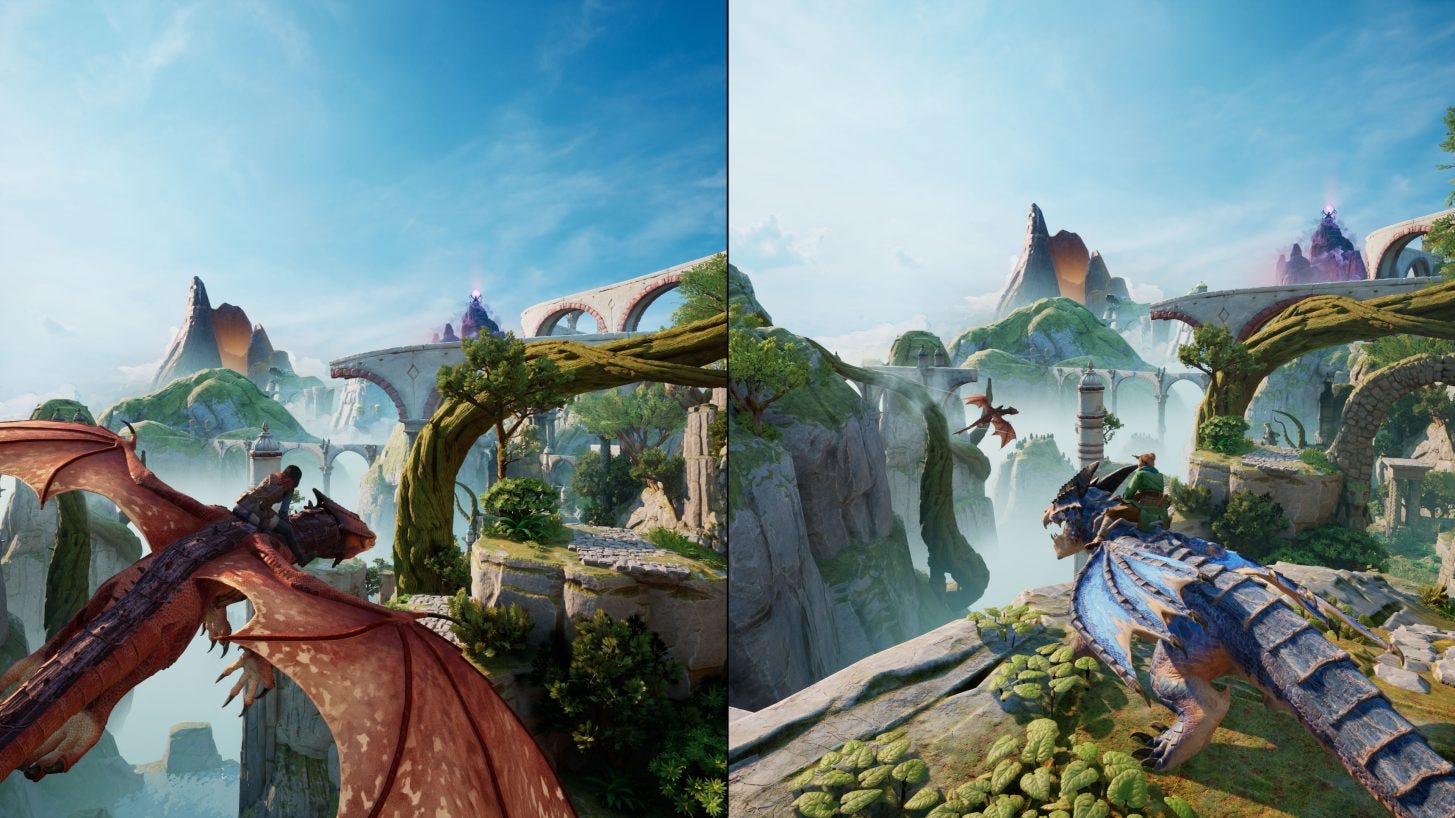
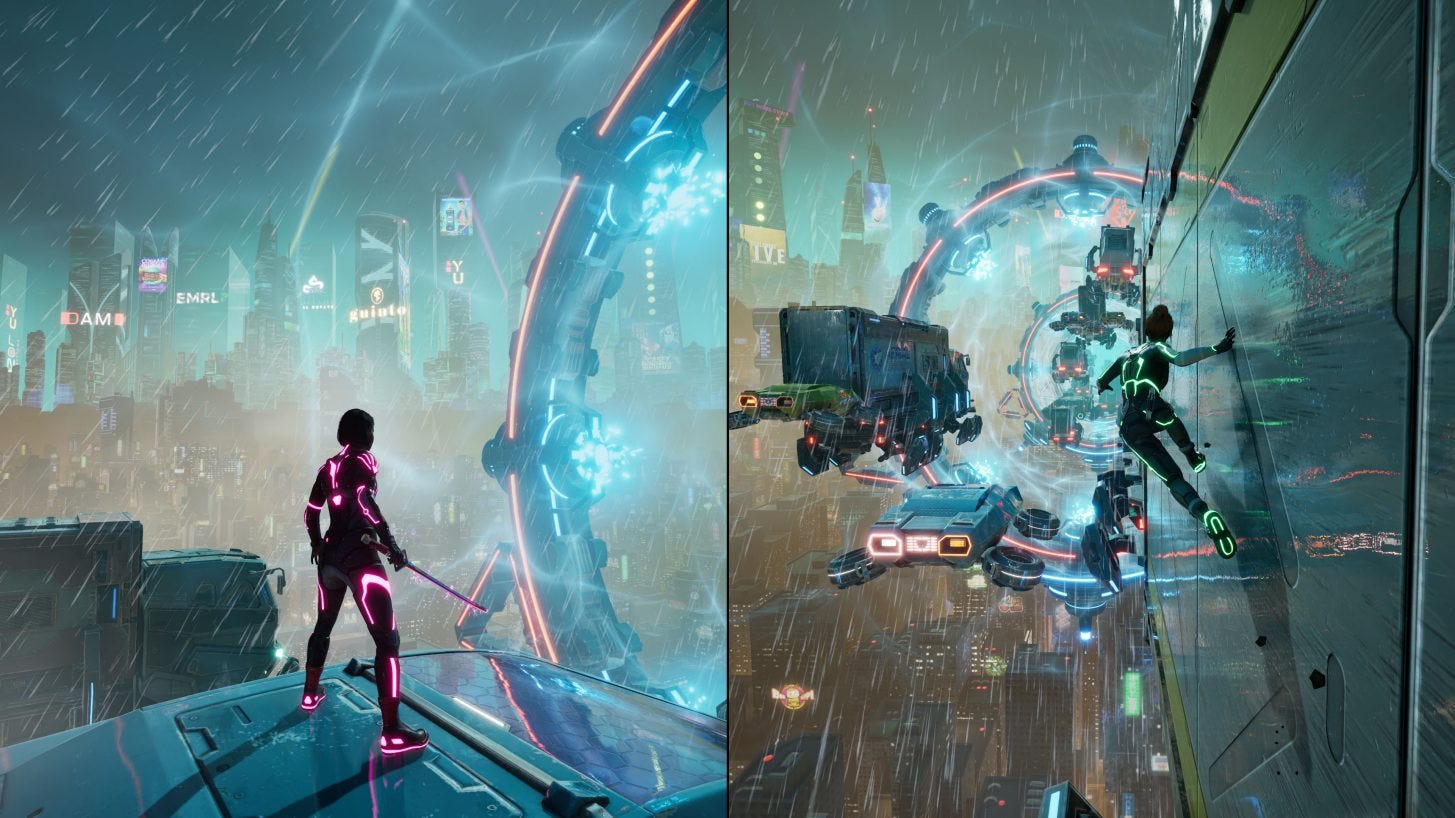
The biggest black eye for the gameplay though is that, simply put, Zoe’s powers suck! It was shocking over the course of our playthrough to find that EJ had gotten the short end of the ability stick time and time again. In the first major world, a cyberpunk city with ninja sword-based melee combat, Mio had the ability to alter gravity to run side-long or upside-down on surfaces placed all over the map — awesome! Zoe had…a whip, for throwing things. In a later Spyro the Dragon-inspired level that featured prominently in the game’s trailers, Mio’s dragon had the ability to fly and spit metal-dissolving acid — sick! Zoe’s…ran into things to break them. Even one particularly strong late-game section that turned a boss encounter into a moving game of pinball saw the hapless Zoe reduced to a jumping silver ball while Mio got to work the flippers to open pathing and launch attacks at the boss character. That sequence was pretty spectacular — for me! But I can’t say with confidence that it was as memorable for EJ as it could have been had Zoe been afforded more agency in the conflict. If the game’s systems fail to inspire both players, and the narrative struggles to compel or even produce many memorable moments, what are you left with?
Mio’s powers generally feel more proactive, almost as if her mechanics are what most of the levels are built around. Zoe repeatedly plays a support role, her abilities serving only to enable her counterpart in playing the actual game. Zoe is often pressing switches, rotating platforms, holding levers, or operating a vehicle while Mio is actively engaging with the world — the discrepancy between the two is staggering, the imbalance enough to make me wonder whether this game should have even been a split-screen experience to begin with. One of It Takes Two’s biggest flaws was the rate with which it introduced (and discarded) new mechanics — in Split Fiction, Hazellight doubles down, and save for some traversal basics, fails to find a conceit that can support the game front to back. Each time we got to experience something interesting, it’d be ripped from us unceremoniously in lieu of something more cumbersome or tedious. - EJ
We’ve led with a lot of negativity here, but let me be clear: this is by no means a bad game, it’s simply one that falls short of the hype created by both Fares and the game review space. And there is also plenty to like if you can live with the poor script and often milquetoast mechanics! Mio’s cyberpunk ninja world had excellent traversal, fun set pieces, and some cool boss encounters that utilized the world’s abilities well — a strong start, to be sure. Late-game worlds also provide some memorable stage design and encounters, such as the aforementioned pinball boss fight and a series of platforming challenges based on each player grabbing and releasing their respective end of a conjoined centipede with two heads. That last bit had us satisfactorily sweaty in its execution, laughing heartily at our gaffes and celebrating our triumphs — especially moments of quick-twitch saves when we accidentally let go too soon or grabbed too early. The very last sequence preceding the inevitable final boss fight against Rader is undoubtedly the most memorable and interesting. I won’t spoil it here, but will obliquely offer that it delivers on the game’s titular promise in genuinely jaw-dropping and occasionally meta ways. One wishes that more of the game’s bulk could have been spent in comparable humor or awe.
The game shines in fleeting moments where both characters are able to work in tandem to accomplish their goal — not trading off button presses or waiting on each other to finish a quicktime event, but when the interplay between both players becomes a marriage of timing and execution, one not able to work without the other. A level that perfectly encompasses these ideals is an early side story wherein an active explosive has to be passed between both players while navigating a fiery obstacle course, the windows on the bomb and the various stage hazards just narrow enough that we had to be all but perfect to complete it. These segments showcasing more intentional co-op are a genuine treat, but feel like an unfulfilled promise, a glimpse at what this world could have been. - EJ
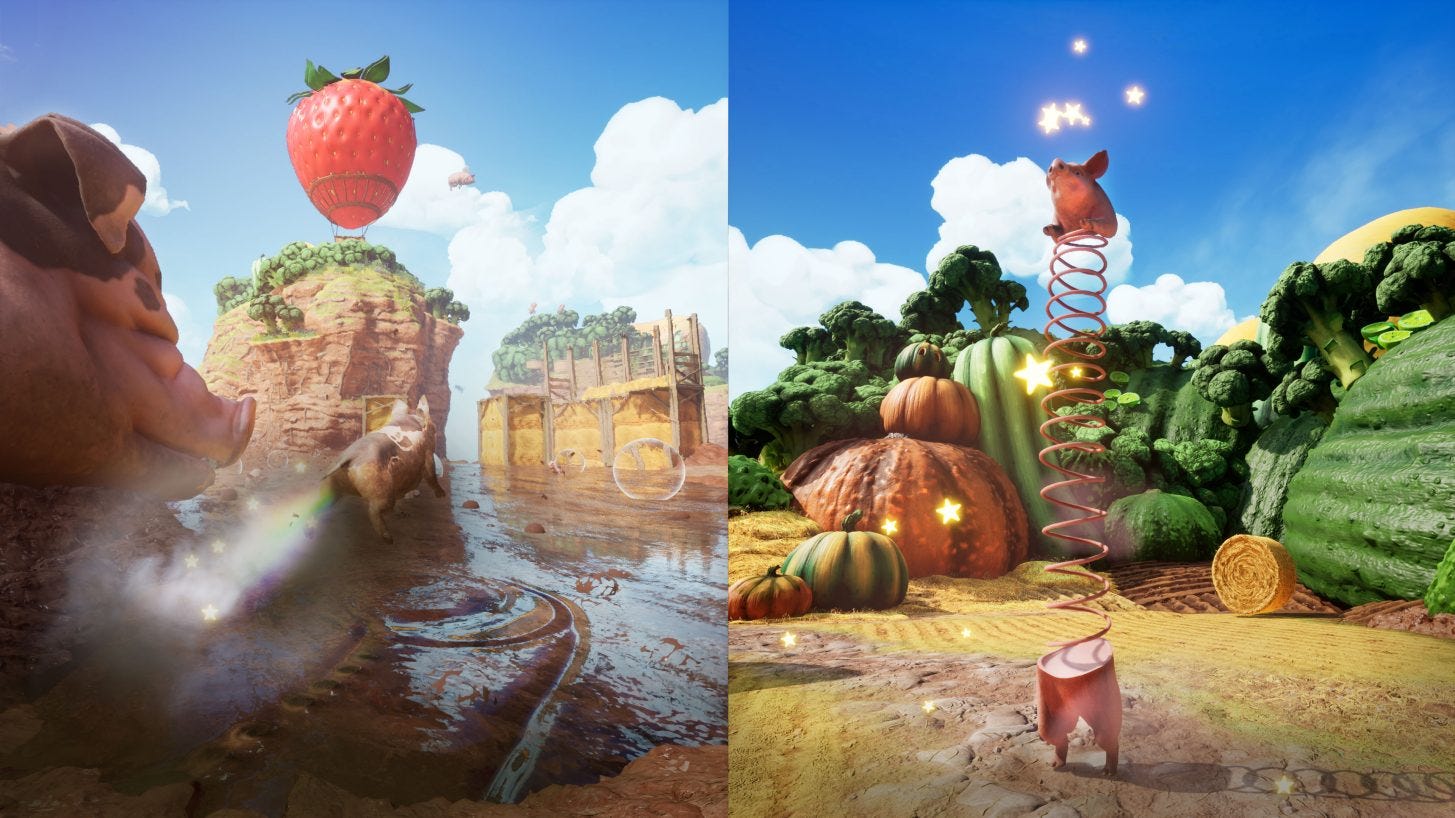
The true highlight of Split Fiction is the game’s many “side stories.” These short forays into undercooked or long-forgotten stories by Zoe or Mio were where the development team had a chance to try more kooky or more experimental ideas than each of the fully-realized worlds may have been able to support. Frequently memorable and occasionally downright hilarious, these ranged wildly in tone and content: a literal storybook in which the world was sketched and erased around us in real time as Zoe narrated; an escape from a world with a dying sun that punctuated each fading pulse of life with a booming electronic BWAHHH worthy of a Hans Zimmer score; an SSX Tricky-inspired downhill snowboard level complete with multiple trick inputs and combo meters; a candy-and-sweets dream world that featured walking teeth completing Fall Guys-esque challenges that later devolved into a Five Nights at Freddy’s robo-dentist boss fight nightmare; and, my personal favorite, pigs that farted rainbows to propel themselves across a platforming stage, which eventually led us to leaping headlong into a meat processor that ground us into hot dogs, slathering ourselves in condiments, hopping into buns, and gleefully celebrating our consumption by a gigantic child. Yeah. Kooky stuff. That these bold, bizarre, beautiful swings would be relegated to optional side content while blander world and ability designs received fully fleshed-out levels is one of my great disappointments with the game. The creative juice was there, but it was squeezed into the wrong container.
While there are a few entertaining ideas plucked straight out of some of our favorite games ever, and even more references beyond that, this game spreads itself too thin in an attempt to be an homage factory. The initial kick of dropping into a Star Fox-inspired on-rails flight level (say the thing, Zoe!), or rolling around as a morph ball in a Power Suit wears off quickly, as it becomes clear Split Fiction sacrifices its own identity to get cute wearing someone else’s face. Chuckling to ourselves when diving headfirst into a leap of faith (complete with a parodistic avian screech) or pointing at the screen like Leonardo DiCaprio every time we get to see a barrel from Donkey Kong only serves to remind us that a few fleeting moments of fun do not a cohesive game make. Many of Hazellight’s missteps — several having been pervasive in their previous titles — are just not as easily forgivable the third time around. Fool me once, and all that. - EJ
So: does Split Fiction measure up to fellow 2025 heavyweights Hades II, Donkey Kong Bananza, and Hollow Knight: Silksong? Not even remotely. I can confidently call this the most inexplicably over-rated title I have ever played, a game that manages to be a letdown in nearly every attempt it makes to develop interesting gameplay, create compelling characters, or iterate on their existing formula. While EJ arrived at this conclusion more quickly, I nonetheless found my way to wondering just how exactly this was holding so much critical acclaim and if it would be fair to question if reviewers were retroactively rewarding the success of It Takes Two on the international stage.
Verdict
Split Fiction’s beautifully designed worlds, occasional highlights, and strong side stories fail to make an impact amidst a mediocre script, poorly balanced mechanics between its two playable characters, and a lack of compelling development for its heroes and villain. True, there was a kind of joy to be had by laughing and cringing together over the game’s many missteps — a testament to the unique “co-op only” role that Hazelight fills in the modern game space — but this cooperative fiction is one you’d be better off to split from.
Split Fiction is an odd smattering of stakeless, on-rail set pieces punctuated by middling platforming segments, with interesting (and sometimes) fun mechanics occasionally being introduced and thrown away just as fast in lieu of more cumbersome, tedious conceits — ones that routinely overstay their welcome. It fills the odd niche of ‘games that can only be co-opped,’ and I guess in that sense does it well enough, but it never really figures out what it wants to be. It feels like a game made for people who don’t play games, more useful for dragging a reluctant friend along than something meant to be enjoyed by people who actually love this hobby. It’s trite in every aspect, generic slop made for a less discerning audience — or maybe just an audience desperate for a little more genuine human connection. Review consensus aside, this was just not a fun experience. - EJ
🌭