IguanaBee, the developers of Skull Island, are a small game studio based out of Chile that have been making games for the past decade. They have a similar pedigree as many devs of this size, bouncing between passion projects, one-offs on experimental platforms, educational games, 4-player splitscreen-em-ups, and license tie-in fodder. It’s clear to me that there was a lot of ambition from earlier stages, based on this interview with lead game designer Guillermo Gomez Zará, but the end product is hardly recognizable from its vision, to the point where any casual observer would have the same questions cross their mind: “What the fuck? Who let this come out this way?”
I wasn’t some unspoiled virgin starting this game up. It was a “prize” bequeathed to me by my gracious co-hosts for a stunning victory in our highly competitive Fantasy Critic league, and by that point, Skull Island was already notorious. It was specifically picked because of its astonishing OpenCritic average, as tribute to my prognostications in our low-scores league specifically. All this to say, I had rock bottom expectations when booting up the game, more curious than anything.
Like any sane person starting a new game, I poked around the settings from the main menu to get myself ready for the journey ahead. Bad news already: there are no camera control settings. Not only is the camera speed immutable, but I also can’t invert the Y-axis. I hadn’t even started the game and I was already hitting roadblocks.
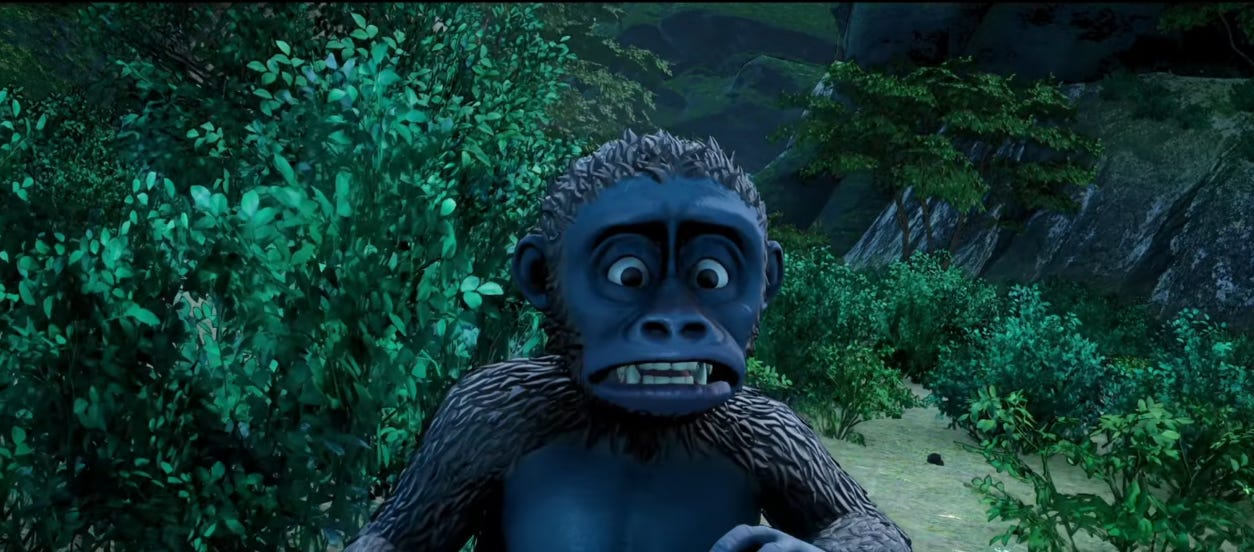
After starting and getting past a narrated animatic cutscene that barely exceeds a storyboard, I’m treated to an incredible load-time to LOD-pop-in true combo. Just a static mountain-y environment and the back of Kong, slouching in a defeated stance, reflecting my own future mental state. The game isn’t ugly, per se — there’s intention behind the high contrast texturing, and there’s some lighting effects that work well to evoke its comic book source. However, I’m playing this on Switch, which is trying its hardest just to give me 30 frames per second, so the low resolution and level-of-detail pop-in compromises that often accompany a rushed cross-platform release really harm the visuals. In particular, the fur effects and bizarre intentional ghosting effect on every movement of the camera adds a noisy shimmer that is just appalling at this scale.
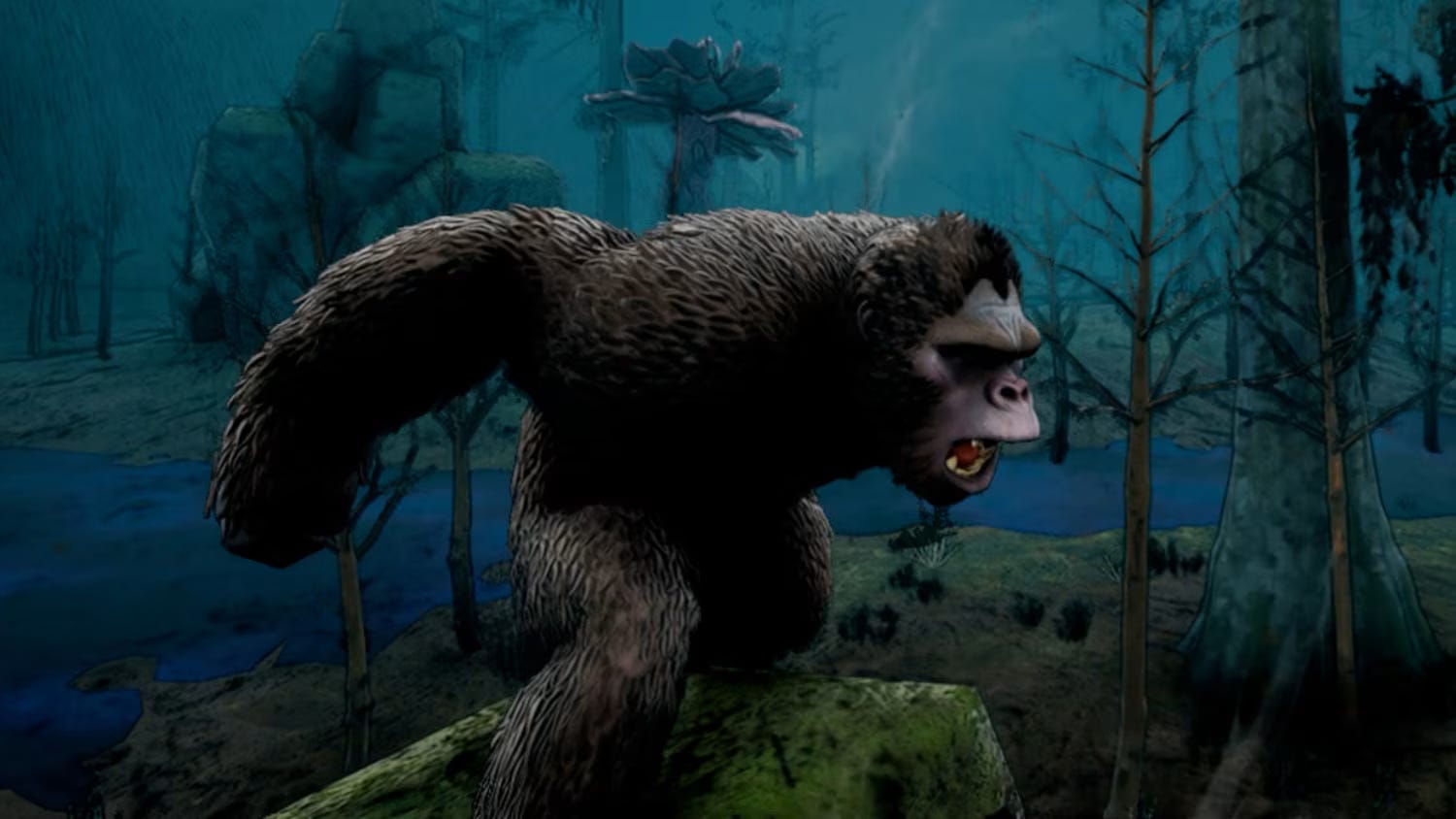
The moving around part of the game is fairly unremarkable. You have a sprint to cover ground at a good speed, and a jump. Littered through the levels are plenty of vine walls, which were always tedious, and often risky. More than a few times I would get stuck “climbing” even after cresting the top, so I’d just climb in place horizontally, mashing buttons and hoping that I could break out of the animation. The non-sprint animation, however, is glorious — just watching a big ape jogging around is worth the extra time it takes to get from A to B.
When I do eventually get to B, it smash-cuts to black. Another treat, this early on? Our narrator tells us how storms are a bad sign (gasp!) and that the father and son were late coming back from hunting. This is truly one of the plots of all time. Also — a twist? We’re playing as momma Kong! The cutscenes barely even pass as a rough draft, with sound effects playing over shaking environment shots and melodramatic animations. I’m experiencing whiplash every time I’m cracked across the back of my head with a load screen at the beginning and end of each one, and even occasionally in the midst.
Combat is introduced next, and it’s about what you would expect: heavy attack, light attack, block, target lock, dodge roll, parry, meter build, spartan rage at home — the whole gamut. Gorilla dodge rolls are very humorous, just casually somersaulting out of the way like Nathan Drake. You even get a chance to use small enemies as projectiles, grabbing and flinging them to your heart’s content. However, I found little glee in the fowl yeeting, as every encounter wore thinner and thinner. The camera is just so atrocious, the lock-on is more likely to put a tree between you and the action, and attack animations barely correlate to what will hit you and what you will hit. Best of all, the foes never lose aggro, so as I sprinted around aimlessly trying to find where to go next, I’d inevitably have a cloud of stray mobs tailing me like the end of Galaxy Quest. I didn’t even notice this behavior until a gut-busting moment where I had set the controller down in search of reprieve only to see a swarm descend upon my Kong and dissolve my healthbar like a school of piranhas.
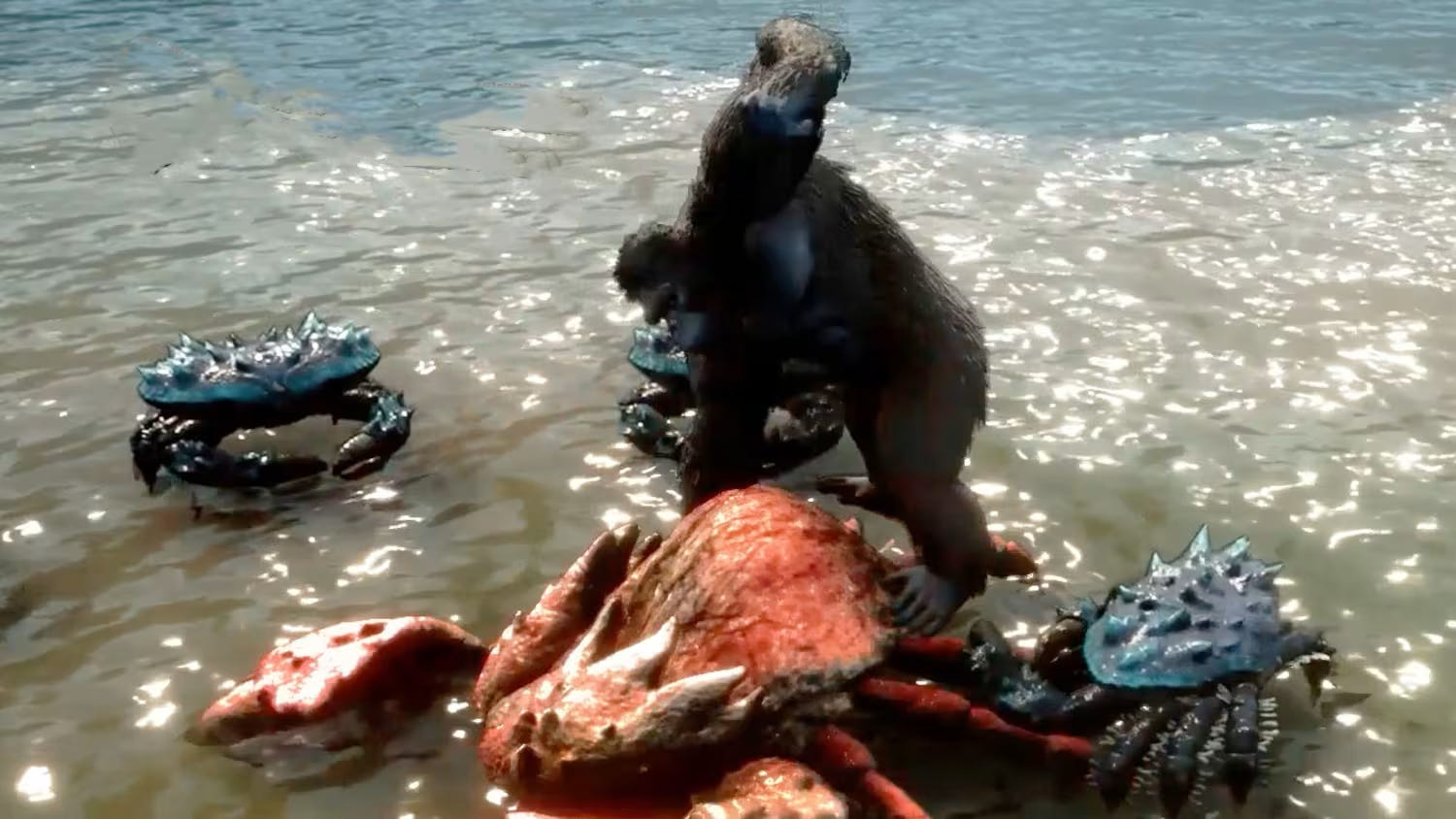
This entire beginning tutorial ends up being an abilitease, and after a climactic confrontation with the biggest and most evil of the dinos, it’s time to throw out all the moderately empowering moves you had a minute ago. Now it’s time to wander around Skull Island for the next 6 hours! You might try to fight some crabs, or little chicken raptors, and wonder: What is my purpose? “Well,” you may be thinking, “This is a beat em up game, so I guess I should fight stuff.” Except, there’s really no incentive to fight the run-of-the-mill beasts you see around you. There are no currencies or item drops to be gained from normal combat, only in the sectioned off combat arenas as you wander into them. From these zones, you gain points to spend in the skill tree. Did I mention the skill tree? It’s not really worth mentioning, except to commend it for allowing me to freely allocate points at any time.
The level design in the opening area with the waterfalls is fine, if uninteresting. There’s a bit too much vine wall climbing, but that holds true for the rest of the game as well. It really falls apart after you make it to a dead end, and the real meat of the game shows itself: the atrocious pathing and layout. The entirety of my time with Kong was spent hopelessly meandering through these asinine jungles looking for the next required encounter. I’d have loved to follow a guide, but that resource just did not exist. Best I could do was scrub through a YouTube video longplay and hope I could reverse engineer their location to mine. Even worse, they somehow made the decision to have a pause screen map, and no indication where you are on it! The only way in game to determine where you go next is by holding a button to have Kong do a big yell, and then scroll the camera around slowly looking for the wiggly white lines marking your objective. These were little to no help, and I’d still spend way too much time running past the same unremarkable terrain repeatedly. If I was lucky enough to stumble onto the next combat encounter, my reward for it was to fight some composition of the same old boring enemies I kite behind me at all times. I’d rather be lost in the woods in real life than try to jump back into this nightmare of dreary, samey locales.
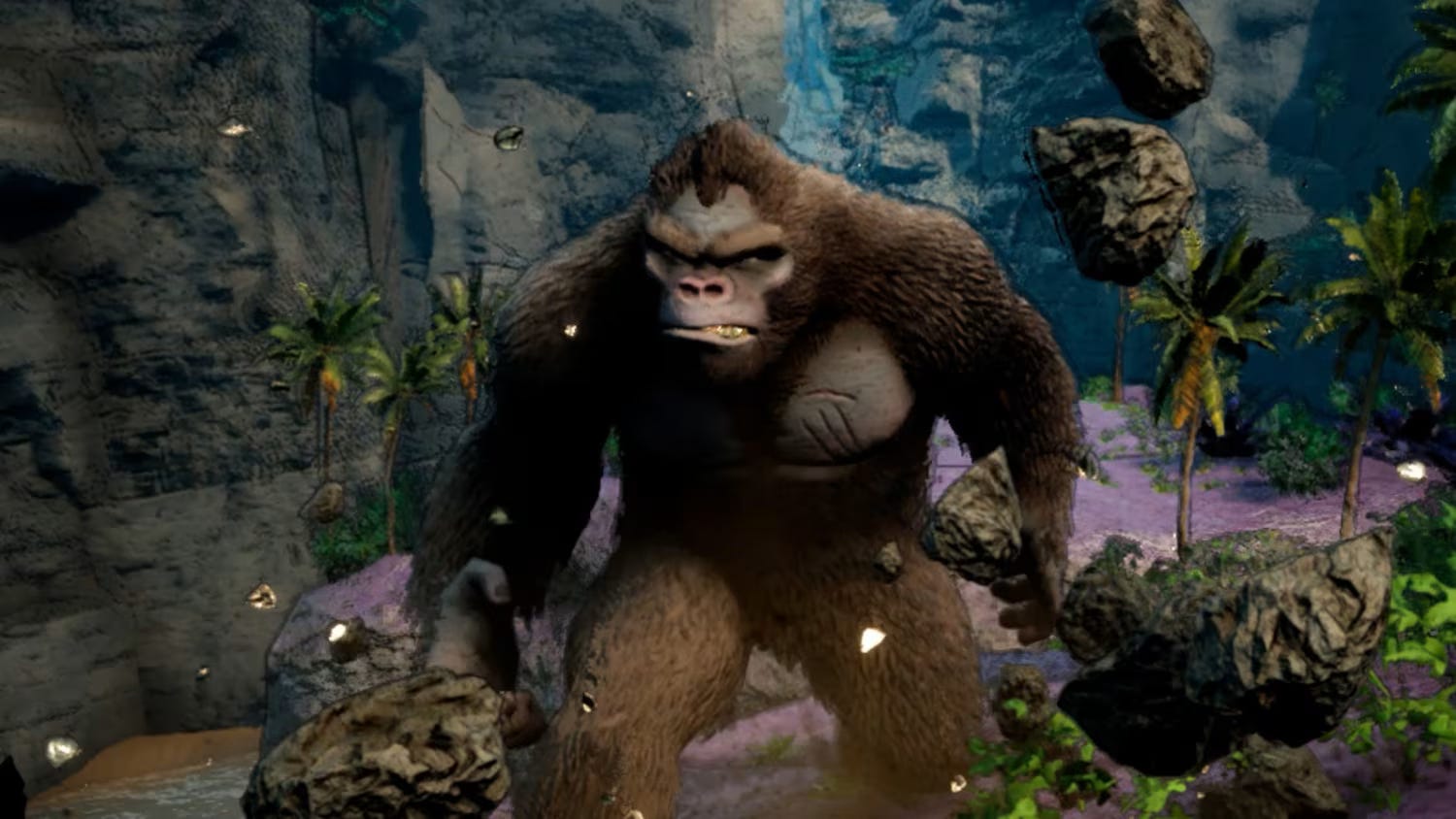
I’d say the one standout is actually the boss encounters… Well, a couple of them, at least. As is foreshadowed in the opening cutscene, there are a few bigger baddies to take down, usually unlocking some ability. The first of them was a terrible worm, which I hated. The encounter seemed like it wanted to be more involved, utilizing the terrain and turning the enemy attacks against it, but that didn’t seem to work no matter how I tried. Instead, I just ran around getting occasional pings for 20 minutes until it was dead. The next boss was actually good! After working my way through a nasty bog, I was rewarded with what any Souls fan could possibly ask for: A fight against a massive crab in a purple swamp. It had great enemy movement, well telegraphed projectile attacks as I approached, up close attacks that I could parry and punish, and it scuttled away to start the loop again. If only the whole game was like this! In the end, though, it never got better than clumsily clobbering this colossal crustacean.
There’s another encounter where I was tasked with fighting three mini versions of the main antagonist, which ended up being oddly trivial. But that was it, no other fights until the final confrontation. Well, in my playthrough that was the case: In my extensive research (watching that same longplay mentioned earlier) I noticed a giant spider I had somehow avoided battling. It actually seems like it would have been a good fight, but I will never know. Instead, I got through the dark and labyrinthine web zone and into the red misty mountaintop environment befitting the final area of any game. This final battle against Gaw was a real pain in the neck, with loads of attacks that I couldn’t dodge or parry, and an immensely irritating shout move that she does that would stun me and give her a free shot (or two). I just had to try again and again, hoping that the AI would be bad enough to not do anything while I was stunned, or give me the attack I knew I could parry. Eventually, I stood victorious, the tyrannosaurus tussle concluded. Of course, Kong does a big yell. Long live the king.
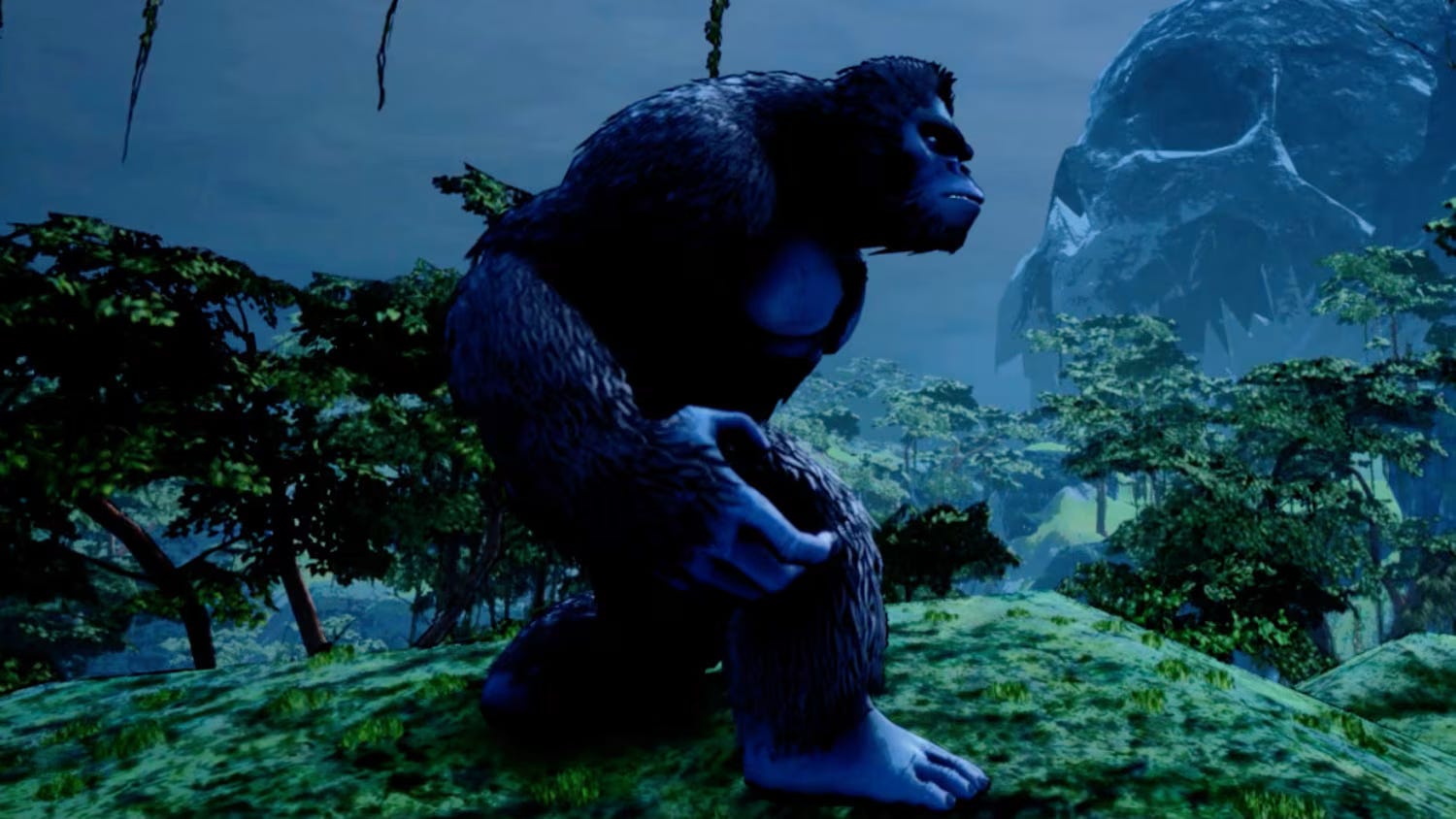
I don’t know how much more I can really say about the design and concept of Skull Island, except to mention that even through the bugs and poor performance, I found my own sordid entertainment. In one particularly egregious battle arena, my framerate had slowed to a crawl, and it was honestly fascinating watching this game as a single-digit FPS slideshow. The checkpoint saves were actually surprisingly functional, and in times like that where it felt I was stuck in a jank hole, a simple reload would often solve it. Other bugs were a little less interesting, like the sound design. I think I remember hearing music 3 or 4 times throughout my entire playthrough, and only in fits and starts. Like someone was trying to kidnap the game audio, a hand over its mouth as it kicked and struggled, trying desperately to call out, but only managing to push out gorilla grunts from the playable character and screeches from the handful of fauna. I was left with a quiet and contemplative time, meditating on the choices I had made.
I really enjoy kaiju movies, like Godzilla and of course King Kong. I love the spectacle and bombast, the literally larger than life characters, incarnations of natural disasters as they wreak havoc without restraint, a punishment for the sins of humanity. This game does nothing with these concepts, instead trudging through a by-the-numbers revenge plot. There are no humans, only some collectible artifacts mentioning them occasionally, so there isn’t even that small layer of interest. In the end, it’s clear what this is: a rushed game based on a license, based on another license, hoping to cash in on the success of the recent movies based on the other license.
By the time I was done with Skull Island, I had totaled 6 hours of game time. A blessing. The presentation is poor, the combat and traversal is mundane, and the level design is inscrutable to the point of hostility. It’s unfortunate because beneath the layers of cruft, I can tell that there were good ideas. People made this game, they wanted it to be the best it could be, but it’s apparent that timelines got shifted or budgets got cut and they had to push this half baked product out the door.
Verdict
Skull Island: Rise of Kong is a dismal and unfinished product, a mean note hastily scrawled to a character that deserves better. Though there were occasionally well designed combat encounters, the vast majority of my time was spent bashing my head against the atrocious level design while the camera did everything I didn’t want it doing. In the end, it was worth it for the laughs, but just barely.