Having received a code for It Takes A War from developer Thomas Mackinnon with no context other than “have fun, let me know what you think,” I took it at face value having only skimmed the Steam storefront page — a silly retro shooter, a janky fan-made one-off meant to emulate and celebrate the classic Counter-Strike experience. I couldn’t have been more wrong. What I discovered was a surprising exploration of internet toxicity, shifting social dynamics, and mental health, and in the process stumbled into a genuine moment of self-reflection. Be warned: it’s not possible for me to talk about this game without spoiling it, so please skip to the verdict at the end of the review if you want to experience It Takes A War devoid of any context.
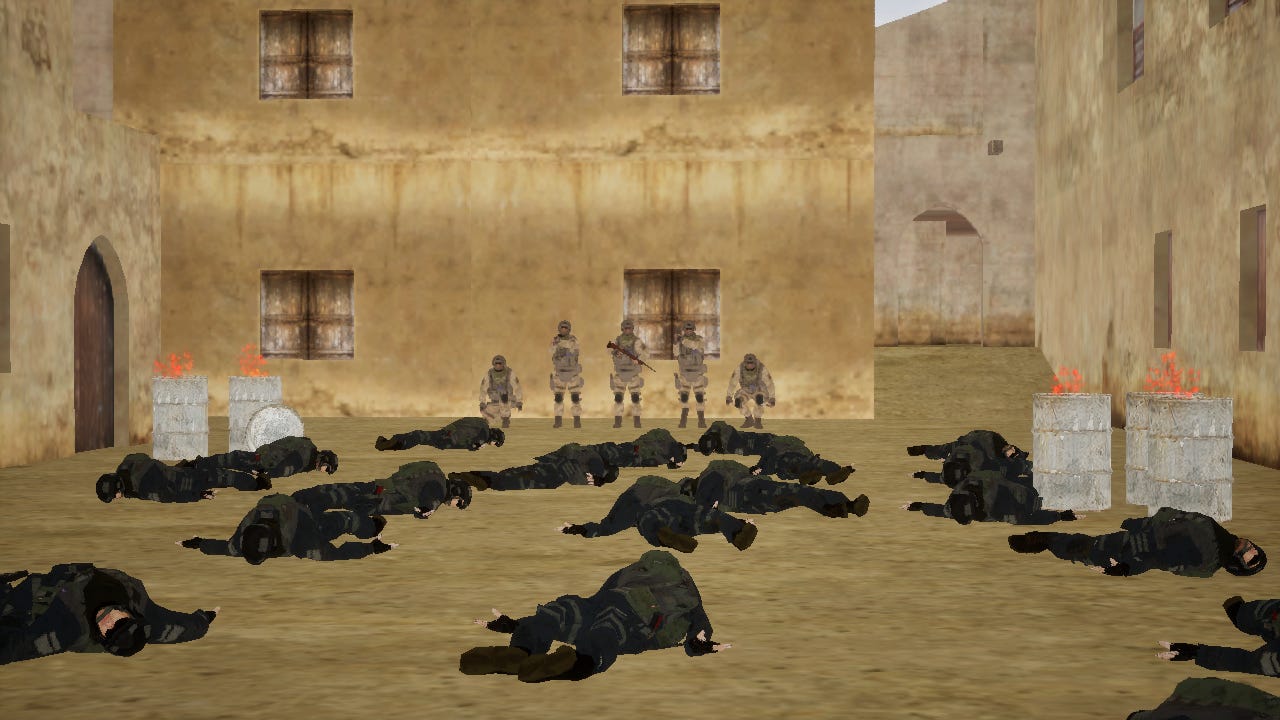
The game is presented as a bare-bones multiplayer shooter, its visuals straight out of 1998. Crude textures and simple polygons make for a nostalgic glimpse into the past, and a choice between three basic loadouts — rifle, sniper, or shotgun — serve to remind how far the genre has come. Loading into a match under the pretense that this was in fact an online shooter, I was prepared to get a little sweaty and kill some bad guys. Instead, I was met with the voice comms of a group of European strangers, lamenting that the rando didn’t have a mic. It immediately became clear this was going to be a bit of interactive theater, and I shifted expectations accordingly: the disjointed gunplay melted away and I was along for the ride as the group prattled on about their favorite crisps.
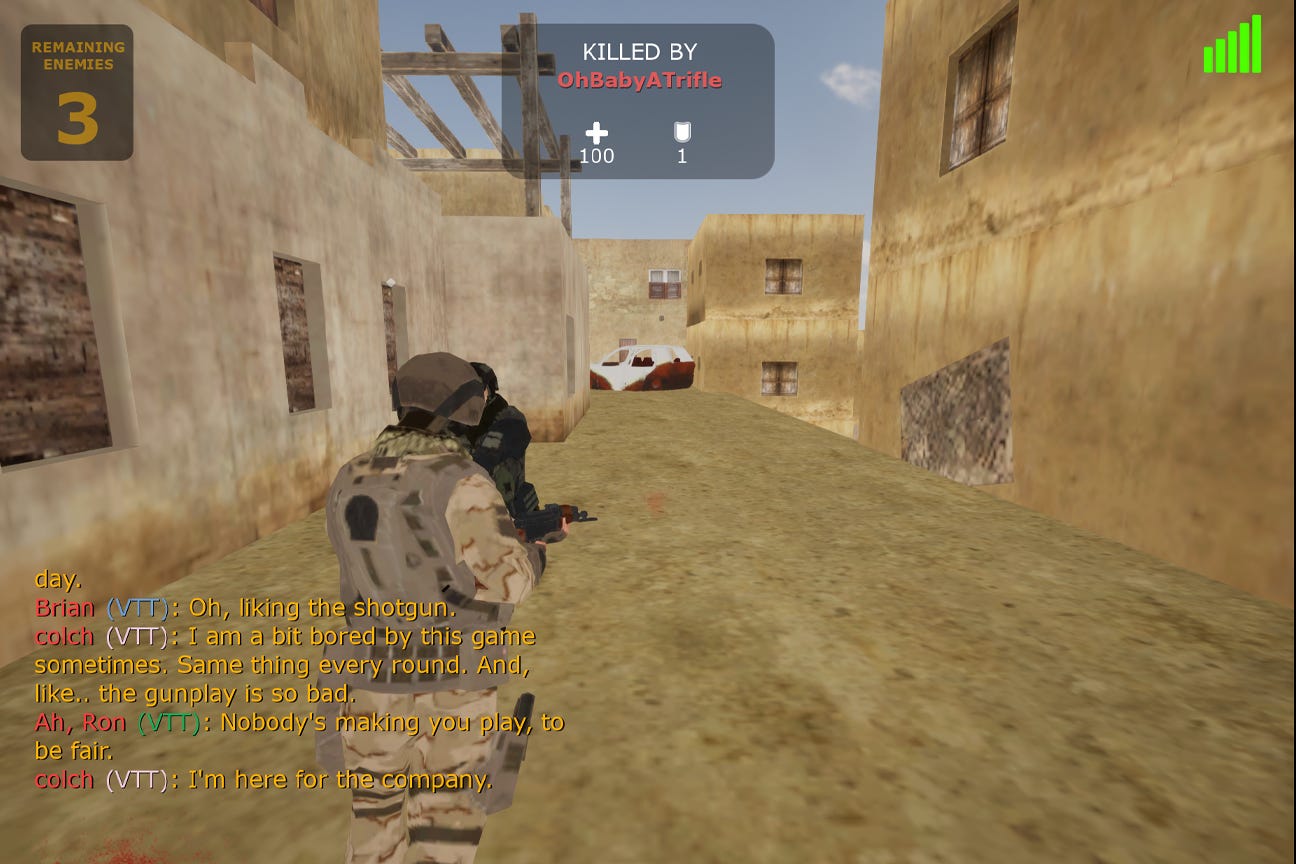
I am a BIG fan of meta stuff like this. Rather than the game simply telling a story, it uses the medium of video gaming itself (by way of this fake Counter-Strike ripoff) as the vessel for an interactive narrative experience. I found myself cringing when my shoddy tactics led to a quick death despite catching on just as quickly as EJ that the other players were pre-recorded — a testament to just how deeply gaming can build investment in fictional souls. When one player would grief another a little too pointedly, I felt somehow ashamed that I couldn’t take up for the aggrieved party — even though I knew damn well they weren’t real. But my lack of microphone access in the fictional game still created a tension between player and story, the gap bridged by my own (admittedly limited) experience in online multiplayer shooters. Fascinating stuff, and territory I’ve wished more games would explore since my jaw-dropping experience with Doki Doki Literature Club back in 2017.
- Chris
After a few rounds of mostly dying and spectating my teammates as they continued to chat, the mundane subsided and oddities began occurring: foreign objects appearing in the sky, audio glitches, visual bugs. Some players in the lobby started having “connection issues,” as others talked about seeing flashes of the real world in the game. Eventually a door manifests, opening as I neared it. Upon entering, I was met with an immediate sense of unease, one I’ve most notably experienced in games like Phasmophobia (a few specific elements in the game’s sound design being eerily similar). At this point I wasn’t sure if It Takes A War intentionally set out to make me feel so uneasy, or if it was just a projection of my own tiny, timid brain — strange things were unfolding, but the narrative thus far seemed to hinge on a particular teammate airing grievances with his playgroup as they took the piss out of him. Was this to play out as a comedy, or something more sinister?
Confusion continued to bubble as characters seemingly repeated lines or recited things only certain players could hear. Colin, the aggrieved teammate, becomes the target of his peers as they point fingers and lambast him for behavior he may or may not have been responsible for. He in turn lashes out, perplexed by the toxicity, and questions what he did to draw the group’s ire. The voice acting here is solid (a Scottish accent makes everything better), and the exchanges are believable enough, to the point that I both felt for Colin as much as I was annoyed by his whining.
Creating the illusion of an online multiplayer game with pre-recorded dialogue is tricky — too naturalistic and the story lacks tension or dynamic shape, too affected and we don’t believe the characters are real people. By and large I was chuffed with how well the writing and performances sold it, although when the world of the game begins to bleed into its characters’ reality (and our own) I started to “see the script” a bit more than before. There was a decent amount of “huh, that’s odd innit…” type of nonplussed responses that quickly returned to “quit being a wanker about not being included, Colin.” Scaffolding a more pronounced overall reaction to seemingly becoming trapped in an online game lobby could have added more gas to the fire when things finally came to head between Colin and the group. - Chris
As I continued through the rounds, shooting enemies between otherworldly visits (supposedly vignettes of each character’s “real-life” homes), my own fourth wall began to crack: first, a few others suggested closing the game in order to fix the glitches. I attempted to crash the entire application with the shortcut Alt+F4 — but instead of immediately closing to desktop, I unlocked a Steam achievement that said “quitting won’t help this time.” I truly was stuck in this lobby. A few crashes later (neither of which I’m sure were intentional), the adrenaline was about to really kick in: the narrative swells as Colin becomes unhinged, lamenting the way these people have made him feel. I end up desperately navigating a black and white maze while messages from my actual Steam friends appear in the bottom right corner, taunting me, egging me on, telling me to GIVE UP. I’m getting a kick out of it as much as I am finding myself genuinely on edge, before a sudden cut to black…and then a knock on my office window. When I say I’ve never jumped so hard in my life — my headphones literally flew off my head — I mean it. A cheap trick, a stereo clip that’s existed for years, truly got me. I was absolutely fried, not looking forward to what would come next…and then the game goes dark again and I re-appear in “EJ’s Media Room.”
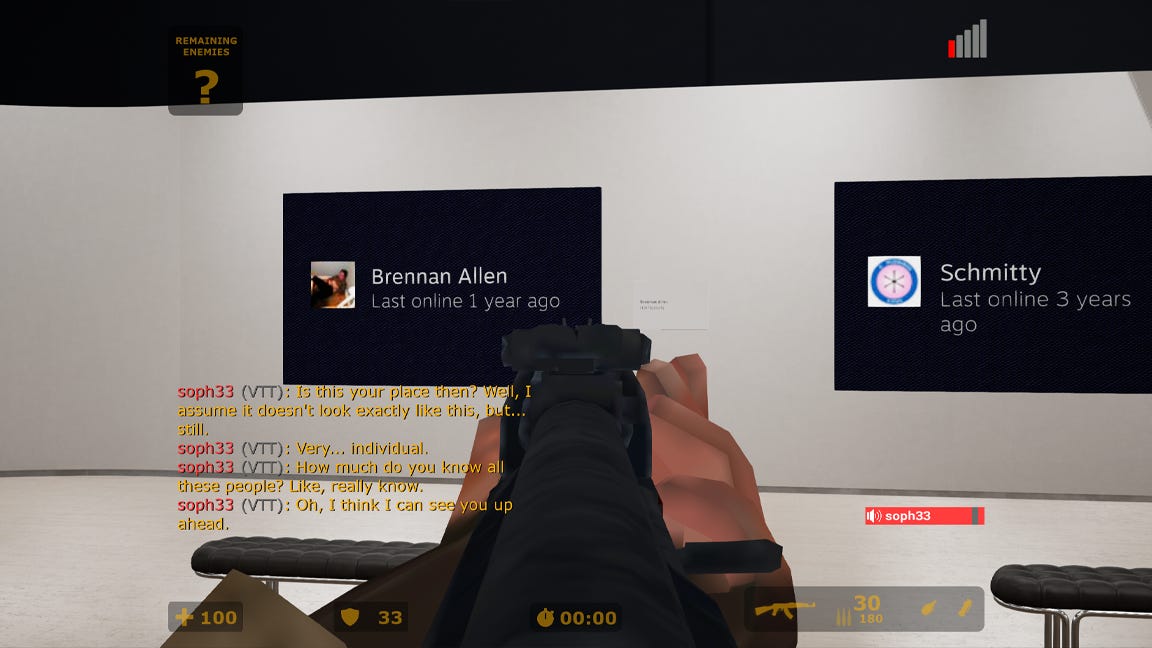
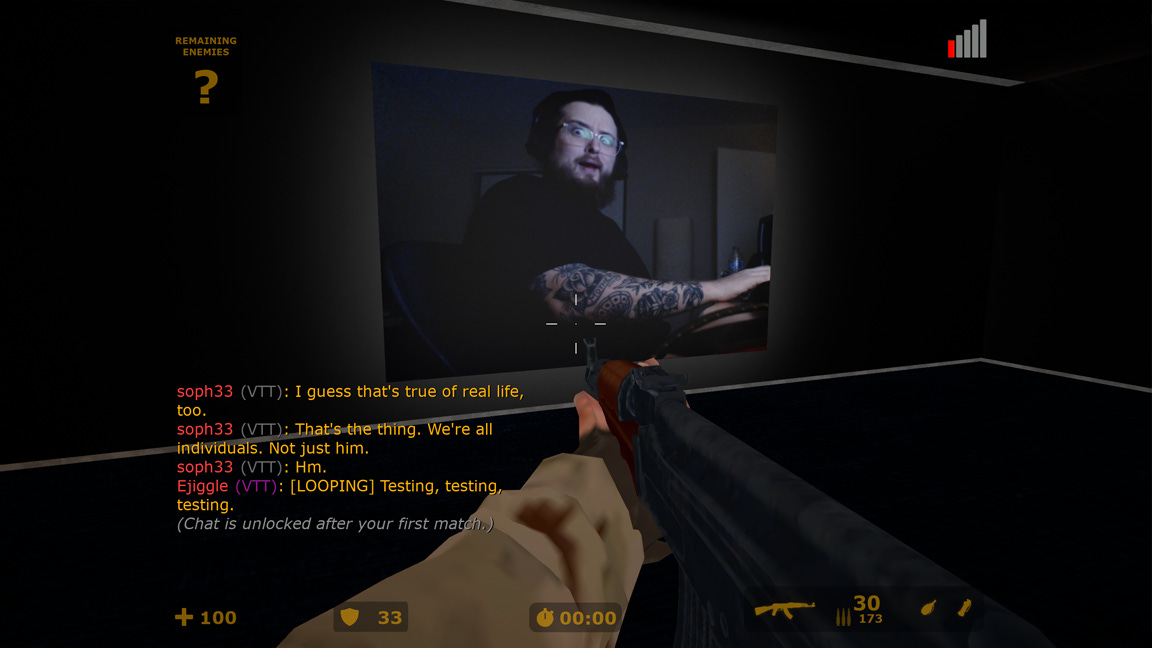
It’s a simple museum, trimmed in white. Framed on the wall are a number of profiles belonging to Steam friends who haven’t been online in…six months. Eighteen months. Seven years. I’m wandering this liminal space, moving from piece to piece as Colin says “All I wanted to do is connect with you lot and you make it feel…impossible to navigate…it makes me feel inhuman.” His words ring loudly in my ears as I’m reminded of all the times in my life I’ve felt similarly, or made others feel that way. I turn the final corner and jump again as I see a live projection of my webcam on full display. It’s an obvious trick, one I saw coming and felt foolish for being surprised by, but it not only paid off the supernatural setup the game had been working towards, but reinforced the narrative themes it’d been building. As I sit staring at myself, I’m torn between the frustration of the game’s pacing issues, and the tension it’d been able to build.
The choice to use a fully-playable fictional FPS as the medium for a narrative experience presents a clear challenge: guide the player through the story to preserve its intended pacing, timing, and impact but also sell the illusion that this is a real video game. It’s a tough line to tread. It’s walked relatively well here, but there was a decent amount of standing around and aimlessly shooting — especially in one particular room, where post-it-notes slowly spawned on the walls one at a time. I must have looked over and shot damn near everything in there five times before realizing the post-its were multiplying, a moment emblematic of the tension between yielding control to the player and steering them through the narrative. I also had a full crash that at first I figured this was an intentional part of the experience. After logging back in and resuming play elicited no comments from the other “players” on the matter, though, it was clear that wasn’t the case — just a regular old crash that broke the flow of a story I was otherwise engrossed in. - Chris

Despite the rough edges, it felt like the game was talking directly to me. Hearing Colin work through his feelings with the group as messages from my actual Steam friends poured in was eerie, reflections of my own experiences dancing through my mind. These themes hit close to home, even in my thirties, as most of my socializing is done via the internet and through this hobby. Group dynamics are ever-shifting and at times subject of much contention (in part to yours truly, a capital ‘G’ Gamer who wears his heart on his sleeve). My own behavior was being called into question by this group of strangers, and the notion that my circles could dissolve because of it was disheartening. Walking through the museum and seeing all of my actual friends who hadn’t been online for years — people I used to talk to and play games with every day — I began to wonder what things might look like in another five years, or ten. As Colin decides to leave his playgroup, I found myself grateful as the reflection of something I know all too well played out its cruelest eventuality on screen. Sometimes the right choice is the most difficult one, and whether that’s moving on from someone you used to love or reaching out to keep them close, I was left appreciating what I’ve got right now, before it’s gone.
I was genuinely surprised at Colin’s choice to leave the playgroup. I think the simpler choice would have been for the group to reaffirm their friendship, or for things to get bloody and dark. After Colin’s daydream about literally crucifying his friends as they babbled eerily calm, artificial lines of praise to him I was confident the latter was the logical endpoint. I was grateful Mackinnon instead opted for the more difficult, nuanced conversation. And while I’m not the online gamer EJ is (one brief but passionate fling with Destiny aside), the game’s ending struck familiar notes to the primarily digital relationship I have with my closest friends half a country away. It’s far too easy online to discreetly exclude squeaky wheels and justify it after the fact, but just as damaging to the person ignored — and healing those wounds is incredibly difficult without the benefits of shared physical space. - Chris
VERDICT
For fans of experiential narrative games, this is likely worth a quick look, especially at the price (currently $5.99 on Steam). While it doesn’t have the polish or the replayability of games like The Stanley Parable or Doki Doki Literature club, the legitimate tension I felt, in tandem with a genuine moment of introspection, made this a welcome, surprising experience.
It Takes a War is a satisfying mind-bender that plays with the video game medium itself to tell a compelling story about the difficulties unique to online friend groups. The writing is solid and the performances believable, but both struggle to sell some of the spookier developments down the line. This is worth playing for anyone who spends meaningful time in digital space with other people, friends or strangers, with the understanding that your experience may be a little rough around the edges at times. - Chris